
TEST PAGE
MV motors layout test
Internal test: hero, a custom HTML block, then a use cases section above the footer.
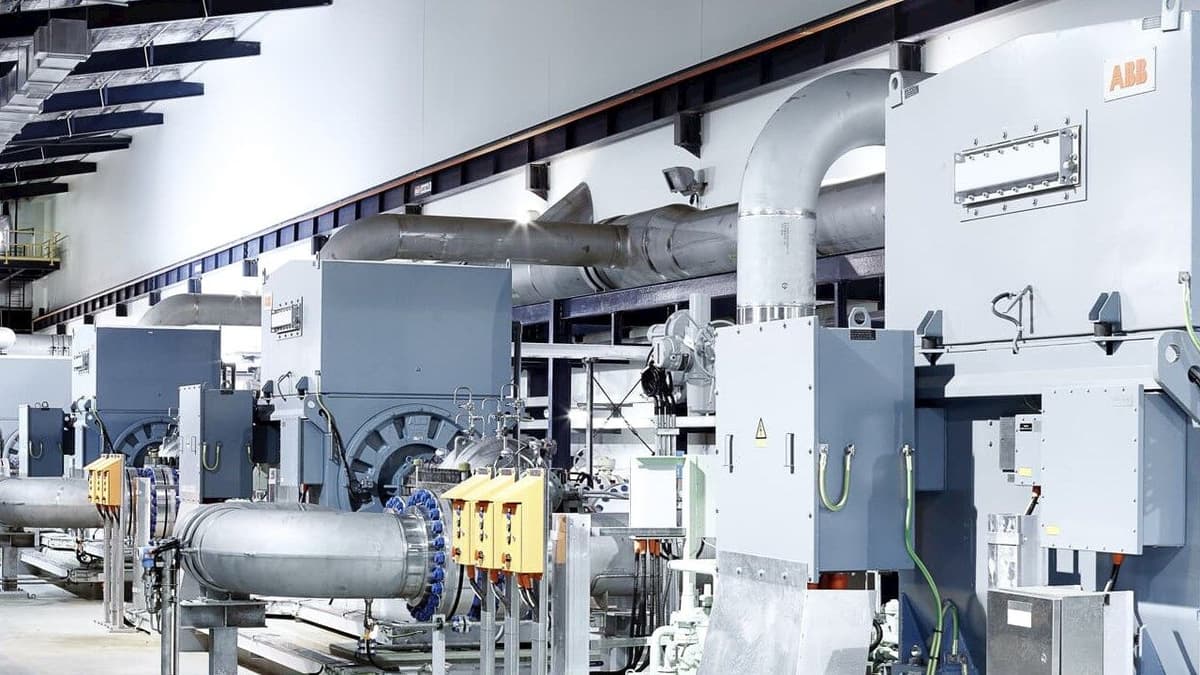
Most MV motors are checked once a year. Failures don't keep that schedule.
When a critical MV drive fails unplanned, the process stops, the replacement is months out, and the post-incident review asks why nobody saw it coming. MV motors operate at 1 to 13.8 kV and drive the equipment a plant cannot run without. Stator insulation degradation accounts for 28 to 40% of their failures. The standard diagnostic is an annual offline partial discharge (PD) test during a planned shutdown. It is a good test. It is also a single photograph of a machine that runs all year.
The test is annual. The degradation is continuous.
PD testing catches what is present on test day. A turn-to-turn fault or a loosening rotor bar can start the day after the test passes and run unwatched until the next shutdown.
The lead time is the real exposure.
A large MV motor can take 6 to 12 months to replace. By the time a failure is visible to the operator, the planning window has already closed.
The most critical assets are the least watched.
Vibration and online PD are fitted to a handful of flagship machines. The rest of the MV fleet runs on the annual test and a thermistor.
Continuous electrical monitoring, from the switchgear.
SAM4 measures motor current and voltage at the switchgear through CTs and VTs (current and voltage transformers) installed in the cabinet. The mechanism is physical. An induction motor is a bidirectional energy converter: a loosening rotor bar, an air-gap eccentricity, or a turn-to-turn fault changes the force on the shaft or the impedance of the winding, and that change modulates the current the motor draws. SAM4 reads that current continuously and resolves the fault signatures inside it.
The electrical envelope.
Stator winding faults, supply quality, phase balance, and insulation trend show up directly in the current and voltage at the cabinet. This is ESA's strongest ground on an MV motor.
Mechanical behaviour.
Rotor bar degradation, eccentricity, and unbalance modulate the current at characteristic frequencies. SAM4 resolves them from the same signal.
Between the tests.
Unlike an annual PD test, SAM4 captures the fault while it develops. That is the only point at which a planned intervention is still possible.
Install at the switchgear
CTs and VTs are installed on the supply lines in the MCC. No motor access. Fitting needs a brief de-energisation in a planned window. MV arc-flash protocols and qualified personnel apply.
Monitor, reviewed by experts
SAM4 watches the current 24/7. Every anomaly is checked by a Samotics analyst against process context and motor history before it reaches you.
Plan the intervention
A confirmed fault arrives with a type, severity, and recommended action. You move the repair into a planned window, while lead time is still on your side.
Feed the outcome back
The result of each action feeds the validation record, which sharpens classification on the next detection across the fleet.
What SAM4 detects on MV motors, and where it doesn't.
MV-specific cases are reviewed individually. The physics SAM4 reads on an MV induction motor is the same physics it reads on a low-voltage one. The MV pathway claims inherit from that evidence base while the MV cohort grows.
SAM4 reads the same current signature on MV that it reads on LV motors. The low-voltage fleet baseline runs above 95% recall on more than 2,000 reviewed fault events. MV-specific recall is published once the MV cohort reaches the reporting threshold.
| Fault class | Signal path | Evidence on this asset | Use SAM4 as |
|---|---|---|---|
| Phase loss and voltage imbalance | Direct electrical | Type ACross-fleet baseline | Primary continuous layer |
| Stator winding faults | Direct electrical | Type BInduction-motor cohort | Primary continuous layer |
| Supply quality (sags, swells, harmonics) | Direct electrical | Type ACross-fleet baseline | Primary continuous layer |
| Insulation degradation, trending | Direct electrical | Type BPrecursor between PD tests | Primary continuous layer |
| Rotor bar degradation | Electromechanical | Type DMV cohort building | Validation candidate |
| Eccentricity (static and dynamic) | Electromechanical | Type DMV cohort building | Validation candidate |
| VFD harmonics and switching faults | Direct electrical | Type BDrive type needs review | Selective method |
| Mechanical unbalance | Electromechanical | Type BVibration leads | Selective method |
| Misalignment with the driven asset | Electromechanical | Type BVibration leads | Selective method |
| Bearing degradation | Transmission path | SelectiveVibration leads on MV bearings | Selective method |
| Absolute PD value and source location | Outside envelope | Not a SAM4 claimPicocoulombs, coil location | Outside envelope: use offline PD |
| Stator core hot spots, thermal faults | Outside envelope | Not a SAM4 claimNot coupled to current | Outside envelope: use thermography, RTDs |
| Lubrication and grease condition | Outside envelope | Not a SAM4 claimChemical state | Outside envelope: use oil analysis |
Detection boundaries
SAM4 reads motor current. A condition that does not change torque, balance, supply, or winding impedance does not reach the signal. We are explicit about four limits on MV motors:
- Absolute PD amplitude and source location. SAM4 trends insulation between tests. It does not measure picocoulombs or locate discharge within a coil. Offline or online PD testing leads there.
- Sleeve bearing condition on large machines. Proximity probes lead. SAM4 covers anti-friction bearings indirectly through load.
- Stator core thermal state. Thermography and motor RTDs lead.
- Sub-450 RPM and synchronous machines with rotor exciters. These fall outside the standard induction-motor signal model and need engineering review.
SAM4 fills the gap between your tests. It does not replace them.
Your critical motors already have vibration and periodic PD. SAM4 is built to sit alongside both. The three columns mirror the role column in the table above.
- Stator winding and insulation trend
- Rotor bar and eccentricity
- Supply quality and phase faults
- Sustained load change
Continuous, electrical, and reaching the cabinet cleanly. The layer that runs between your shutdowns.
- Mechanical unbalance
- Bearing condition
- General health trending
SAM4 gives the early trend and covers motors with no vibration sensor. Vibration gives the root-cause detail on those that do.
- Absolute PD measurement and location
- Sleeve bearings and shaft orbit
- Stator core thermal state
These keep their place. SAM4 adds the continuous layer between them, fleet-wide, at a fraction of the per-motor cost.
One avoided outage pays for the fleet.
The logic on MV is simple. The replacement lead time is long, the production loss is large, and the failures cluster in modes SAM4 sees early. Continuous monitoring converts an unplanned outage into a planned repair, and a planned repair costs a fraction of an emergency one. For a fleet that lacks individual monitoring, SAM4 is the first continuous layer of coverage, at a fraction of the per-motor cost of fitting vibration and online PD to every machine.
From annual snapshot to continuous evidence.
Today you defend the most critical motors in the plant with one test a year and a thermistor. With SAM4, you walk into the reliability review with a continuous record of every MV drive, a classified list of what is developing, and the lead time to act on it. The motor that used to fail without warning now fails on your schedule, in a planned window, on your terms. That is the difference between managing the fleet and being surprised by it.
Evidence maturity is not the same as role.
The table states how to use SAM4 for each fault. The evidence tier states how proven that is on MV today. Here is what each tier means.
How the MV evidence base grows
- Each MV alert is followed up against the customer-confirmed outcome
- Cases are scored independently: detected, missed, or false alert
- Pathways resolved on the LV fleet inform initial scoping and severity
- A fault moves from physics candidate, to case-led, to a published band as the cohort grows
Evidence tiers used on this page
- Type A
- Field-validated. Large reviewed cohort, rounded band published.
- Type B
- Fault-mode evidence. Varies by mode or configuration.
- Type D
- Case-led. Documented cases; cohort not yet ready for a pooled metric.
- Outside
- Not a SAM4 claim for this asset. Use the named alternative.
Validation report
Exact counts, exclusions, fault mix, misses, and review rules are available to qualified technical evaluators. Email engineering@samotics.com.
Use cases
Placeholder use cases for the MV test page.
Use case 1
Placeholder description of an MV motor use case. Replace with a real example.
Use case 2
Placeholder description of an MV motor use case. Replace with a real example.
Use case 3
Placeholder description of an MV motor use case. Replace with a real example.