
Fan & blower monitoring
Fan and blower monitoring
SAM4 measures current and voltage at the cabinet to assess faults that affect motor and fan load. Applications include belt-driven fans, process blowers and aeration equipment. Review the fault evidence and fit criteria for each configuration below.
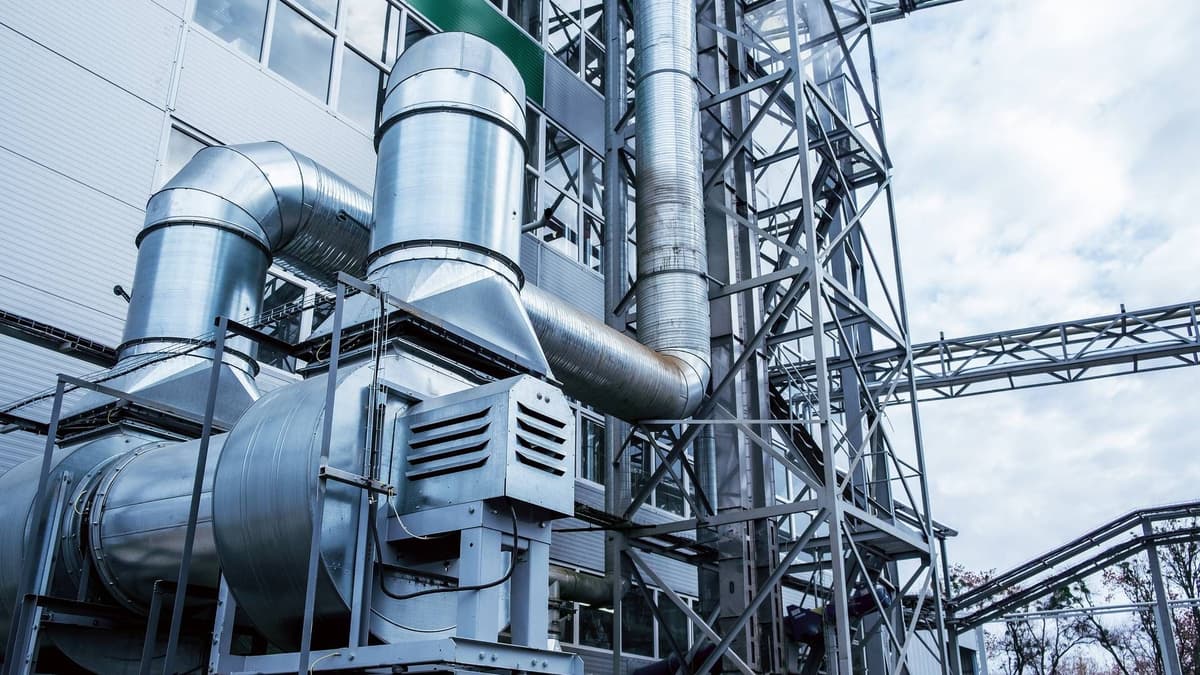
Why fan monitoring can be difficult
Plants don't skip fan monitoring because it doesn't matter. They skip it because the sensor location is wrong. Vibration on fans means mounting on hot ducts, elevated frames, or in ATEX zones. ESA reads the same asset from the motor control cabinet. Two columns: what plants have tried, and what changes when the sensor moves.
Per-asset vibration on fans
What plants have tried, and why it stalls.
- Sensors must be mounted on the bearing housing, requiring direct access to the asset
- Hot exhaust ducts and corrosive atmospheres degrade sensors and cabling
- Elevated and confined-space mounts add safety and labour cost
- ATEX zones restrict standard accelerometer mounts
- Sensors live in the same hostile environment as the fan
- Walking routes miss faults that develop between visits
Result: most plants monitor a few critical fans. The rest run unmonitored.
ESA at the motor control cabinet
What changes when monitoring moves to the MCC.
- One sensor per fan, installed inside the existing MCC panel
- Cabinet-side install requires no access to the fan or ductwork
- Sensors live in a clean, climate-controlled cabinet, not a hot duct
- ATEX-compliant by location: the cabinet, not the fan
- Standard electrical work, scheduled with operations
- Continuous reading on every monitored asset, not periodic spot-checks
Result: every monitored fan reports continuously, from a place engineers already reach.
Motor and drivetrain measurements from the cabinet
SAM4 measures current and voltage at the motor control cabinet. From those signals, it extracts torque modulations, speed variations, and spectral patterns that reveal the condition of the motor, bearings, belt system, and impeller. Without a single sensor on the fan or ductwork.
Load signature analysis
A fan's motor current reflects total aerodynamic and mechanical load. Fouling, erosion, damper issues, and system resistance changes all shift the torque demand pattern. SAM4 tracks these shifts against a healthy baseline and flags deviations before they cause efficiency loss or failure.
Belt and drivetrain frequencies
Belt frequency, pulley order, and belt harmonic components are clearly visible in the current spectrum. This is one of ESA's most reliable detection categories. Bearing defects in the motor and fan bearings create characteristic fault frequencies (BPFO, BPFI) that modulate the motor current.
Motor electrical health
Stator winding degradation, broken rotor bars, and supply quality issues are detected directly from the electrical signature. These faults account for 5–10% of fan failures and are invisible to vibration monitoring or visual inspection.
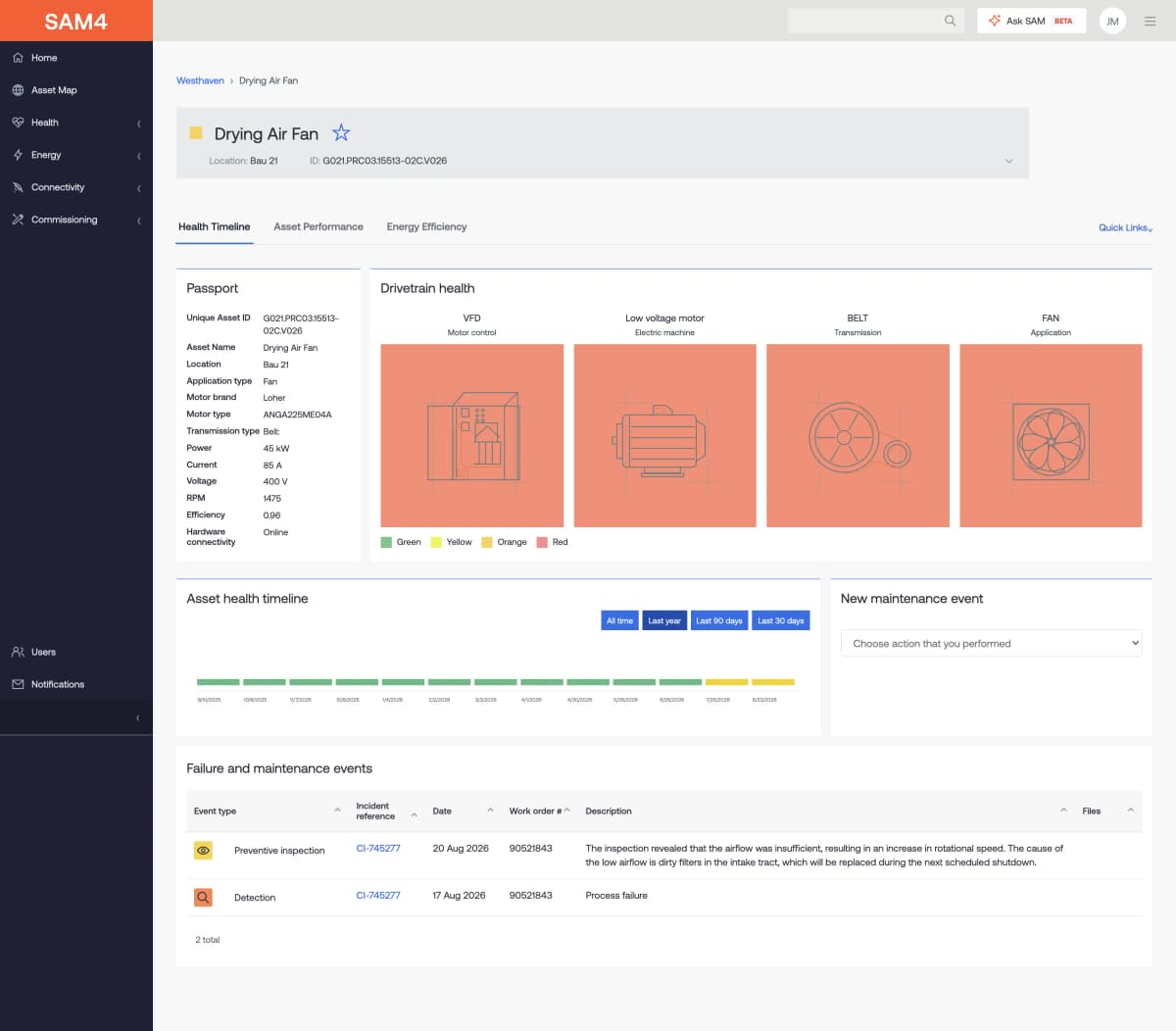
Fan health and drivetrain context. Review the fan, motor and drive together, then use the health timeline to see the recorded findings and events.
Illustrative product view with fictional identifiers.
Signal flagged
Expert review
Fault classified
Action recommended
What SAM4 detects on this asset, and where it doesn't fit
One table. Each fault class appears once with its signal path, the strength of field evidence on this asset class, and the recommended use of SAM4. The signal path is defined by physics. The recommendation reflects what we suggest you act on.
| Fault class | Signal path | Field evidence on this asset | Use SAM4 as |
|---|---|---|---|
| Belt degradation | Transmission path + belt-pass frequency. Sub-synchronous belt-pass passes cleanly through motor inertia at any motor size. | 11 detected, 1 missed in the reviewed cohort. Strongest pathway on belt-driven fans. | Primary monitoring |
| Phase loss and voltage imbalance | Direct / electrical. Resolved at the cabinet from current and voltage symmetry. | Cases reviewed. No misses observed in the sample. | Primary monitoring |
| Process-induced load deviation | Load signature. Sustained load shifts and operating-point drift reach the current as torque change. | 5 detected, 0 missed in the reviewed cohort. | Primary monitoring |
| Mechanical unbalance | Load signature + 1x running speed. Reaches motor current through the rotor. | 5 detected, 0 missed in the reviewed cohort. Broad sub-type spread across rotor and blade unbalance. | Primary monitoring |
| Belt misalignment / tracking issue | 2x pulley-speed signature. | Small sample reviewed. Pattern detected consistently. | Conditional |
| Pulley degradation | Pulley-order signature in the current spectrum. | Small sample reviewed. Detected via load-pattern shift. | Conditional |
| Shaft or coupling misalignment | Load signature + 2x. | Small sample reviewed. Vibration phase analysis discriminates root cause. | Conditional |
| Gearbox degradation or gear-mesh anomaly | Output-shaft signatures coupled to the motor (where gearbox-driven). | Small sample reviewed. | Conditional |
| Soft foot indicators | Distinctive base-mounting signature in the current. | Small sample reviewed. | Conditional |
| Fouling or contamination causing load change | Long-window load signature drift. | Small sample reviewed. Detected via motor electrical signature shift. | Conditional |
| Stator winding short indicators | Direct electrical. | Pathway established across asset classes. Fan-specific cohort still building. | Conditional |
| Rotor bar degradation | Indirect electromagnetic. | Pathway established across asset classes. Fan-specific cohort still building. | Conditional |
| Surge precursors on high-speed blowers | Load signature + current variance under load instability. | Pattern observable. Severity not graded. | Conditional |
| Bearing degradation | Indirect electromagnetic + load. Drive-end bearings visible; impeller-side bearings attenuate with distance. | 1 detected, 1 missed in the reviewed cohort. Vibration on accessible critical fans remains the better tool for raceway-level diagnosis. | Late-stage detection |
Outside the envelope: Impeller blade crack propagation: Not claimed. Use NDT before mass shift. Acoustic signature drift on high-speed centrifugals: Use acoustic methods. Duct or plenum leakage isolated from fan load: Not claimed.
What ESA covers. What vibration covers. Where they overlap.
Fans operate in hot exhaust ducts, corrosive atmospheres, and elevated positions. Mounting and maintaining vibration sensors on fan bearings in these environments is expensive and hazardous. ESA monitors from the motor control cabinet. Each technology fills gaps the other cannot reach.
ESA leads
- Impeller fouling and erosion (load change detection)
- Belt system faults (belt frequency, pulley order, harmonics)
- Motor electrical faults (stator winding, rotor bars, power quality)
- Process deviations via load signature shift
- Energy waste from mechanical inefficiency
Both contribute
- Blade/vane unbalance: ESA detects via 1× component, vibration confirms severity and phase
- Misalignment: ESA detects 2× component, vibration discriminates misalignment type
- Mechanical unbalance: ESA sees load variation, vibration provides localised diagnosis
Vibration leads
- High-speed shaft bearing defects (insufficient torque modulation for ESA)
- Foundation and structural vibration
- Duct resonance and housing vibration
- Bearing overheating (temperature-based, not electrical)
Combining ESA and vibration for fan monitoring
Plants with 20+ fans face a scale problem. Per-asset vibration monitoring on every fan is prohibitively expensive. Especially when fans sit in hot ducts, on rooftops, or in hazardous zones. ESA monitors every fan from the MCC at a fraction of the cost.
For the small number of truly critical fans: primary combustion air, mine ventilation, main process blowers. Add vibration for bearing-level diagnosis. ESA covers the fleet. Vibration covers the exceptions.
Real faults caught on fans and blowers
Representative detections from fan and blower deployments. Each follows the same evidence chain: signal flagged, fault hypothesised, action recommended, customer inspection, outcome confirmed.

Control change would reduce aeration blowers’ energy cost by 5% overnight
The blower station was running more capacity than the process needed. Changing the control strategy saves €120k a year with no capital spend.
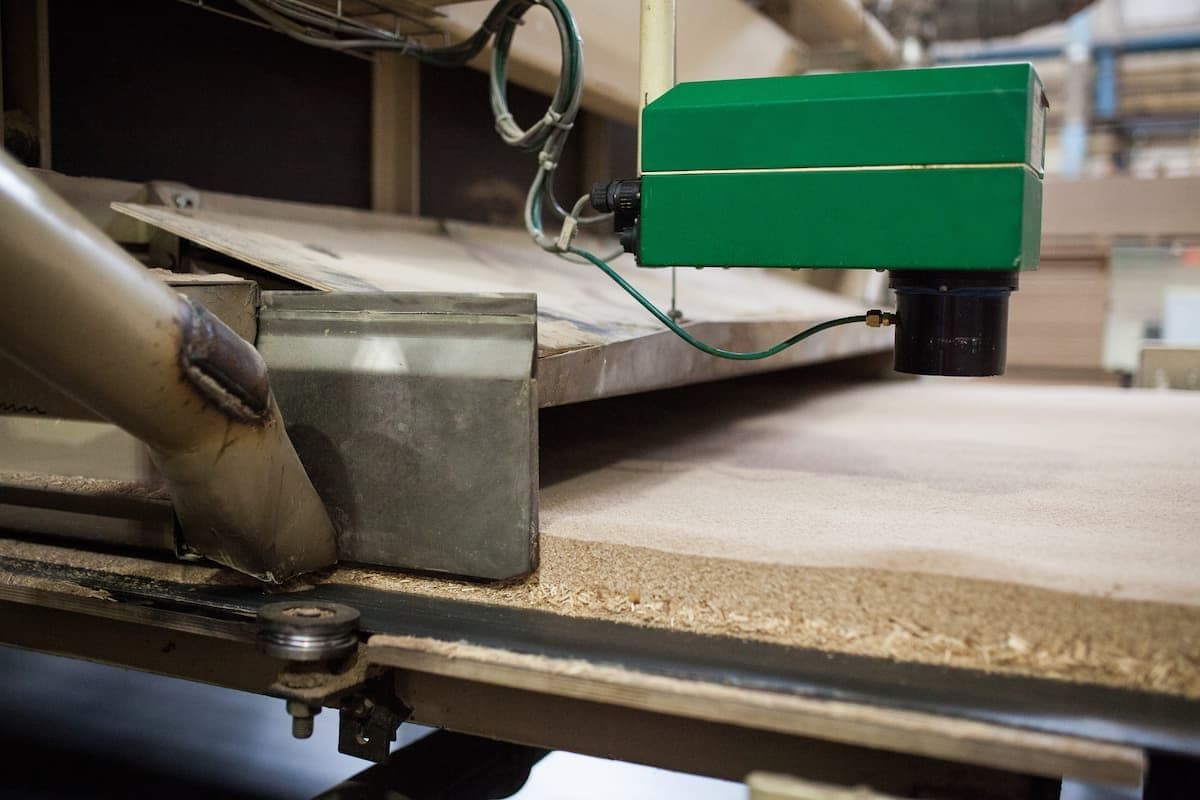
Six early alerts to degrading fans save up to 12 hours and €96k in unplanned downtime
Exhaust fans on a wood panel line were degrading unnoticed. Six early alerts let the plant fold every repair into a scheduled stop.

Preventing downtime on belt-driven equipment
Belt wear rarely shows on a vibration route until it is advanced. SAM4 reads belt-pass frequency at the cabinet and flags the drift weeks earlier.
Under 60 minutes. No access to the fan or ductwork required.
1. Open the motor control cabinet
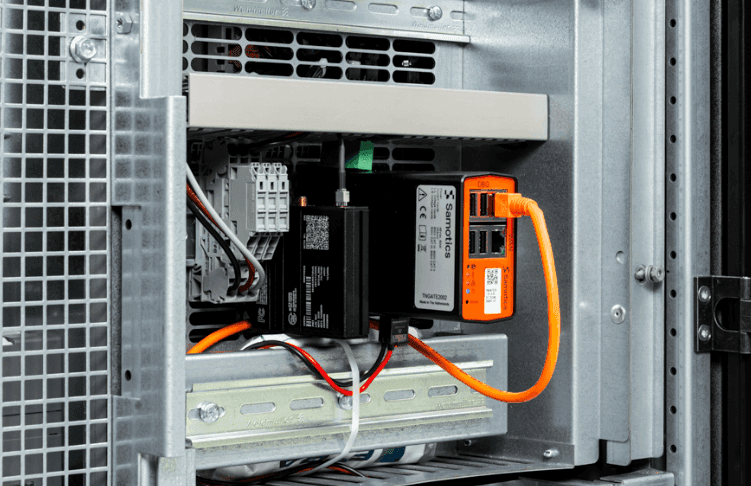
SAM4 installs at the MCC, the same panel your electricians already access. No confined space entry, no scaffolding.
2. Clip sensors onto motor supply cables
Current and voltage sensors clip directly onto existing motor cabling. Installation requires a brief motor de-energisation while sensors are fitted, typically scheduled with operations. No wiring changes.
3. Connect and commission
The SAM4 gateway connects via cellular (4G/LTE). No dependency on your IT network. Monitoring starts immediately. First diagnostic results within 48 hours.
Industries using SAM4 on fans and blowers
Chemicals
Chemical plants run continuous processes with thousands of motor-driven assets. Many sit in hazardous zones where.
Airports
A large airport runs 500-1,000+ electric motors in its baggage handling system alone. Add HVAC, escalators, and cargo.
Pulp & Paper
Pulp and paper mills run hundreds of motors from the wet end to the winder. Most have no condition monitoring. SAM4.
Metals & Mining
Smelters, steel mills, and mining operations run 24/7 on motor-driven equipment that sits in places sensors cannot.
How this page is validated
Reviewed evidence from the 12 months ending 2026-05-01. The fan and blower sample is below the 50-case threshold for a single headline figure, so this page reports per-fault detected and missed counts case by case. The cards below describe how the evidence base grows and what evidence is available today.
How the fan and blower evidence base grows
- Each alert SAM4 raises on a fan or blower is followed up against customer-confirmed outcomes
- Cases are scored independently: detected, missed, or false alert
- Sub-types are tracked separately: belt-driven and direct-drive fans, centrifugal and vane blowers
- 38 scored cases over the 12 months ending 2026-05-01, 0 false alerts
- Field evidence on this asset moves from a clear signal path to case-by-case proof to a published metric as the evidence base grows
What the validation report contains
- Case-level detail with signal trace, asset context, and resolution
- Exclusion criteria and review rules
- Pathway-level breakdown by fault mode and sub-type
- Available to qualified technical evaluators
Other asset types SAM4 monitors
Pumps
Centrifugal pumps in water, chemicals, oil & gas, and process industries.
Compressors
Reciprocating, screw, and centrifugal compressors across process industries.
Conveyors
Belt conveyors, screw conveyors, and chain drives.
Agitators & mixers
Reactor agitators, tank mixers, and blenders.
Review your fan and blower fleet.
30 minutes. We map your fan and blower assets, identify which are in scope for ESA, and show you the detection coverage you'd get. Engineer-to-engineer. No SDR layer.