
SAM4 Platform
SAM4 condition monitoring
Review developing faults, supporting evidence and recommended maintenance actions in SAM4. The platform combines cabinet measurements, electrical signature analysis and Samotics diagnostic support. Your engineers decide how to respond.

What is SAM4?
SAM4 is a condition monitoring system that helps your team understand developing faults and decide what to do next. It combines electrical measurements from the motor control cabinet with automated detection and Samotics’ diagnostic expertise.
Your team receives the likely fault, supporting evidence, an assessment of urgency and a recommended next step. Your engineers combine these with operating conditions, maintenance history and production priorities to decide whether to inspect, plan maintenance or continue monitoring. Samotics provides diagnostic support when you need to discuss a finding.
Samotics brings the diagnosis
SAM4 captures the electrical signal, identifies likely faults and provides supporting evidence and a recommended action. Expert review follows the agreed monitoring service.
Your team brings the plant knowledge
Use operating conditions, maintenance history and the consequences of failure to assess the recommendation. Decide what work is needed and feed back what the site inspection finds.
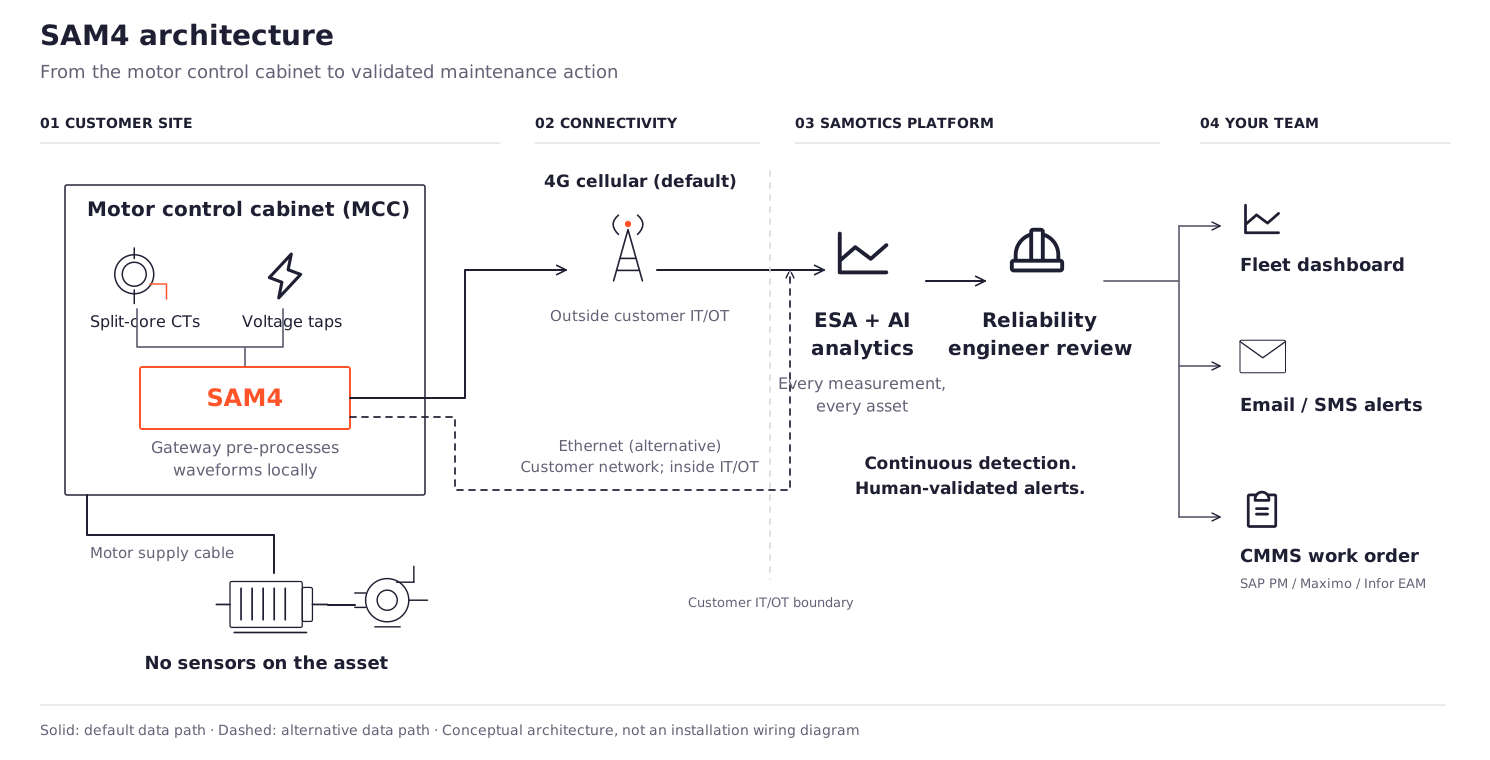
SAM4 works alongside vibration systems, SCADA, and maintenance planning tools. It closes the monitoring blind spot around AC-motor-driven assets where mounted sensors are impractical, unsafe, or too expensive to maintain.
From cabinet measurements to your team’s decision
Your team’s maintenance decision
You decide how and when to act
Assess the evidence
Review the likely fault, urgency and Samotics’ recommended next step.
Apply plant knowledge
Consider operating conditions, maintenance history and production priorities.
Choose the response
Inspect, plan maintenance or continue monitoring. Share what the site finds.
What your team sees
Start with the fleet, open an asset and review its incident. Use supporting evidence, energy insights and pump-performance views to substantiate your team’s next action.
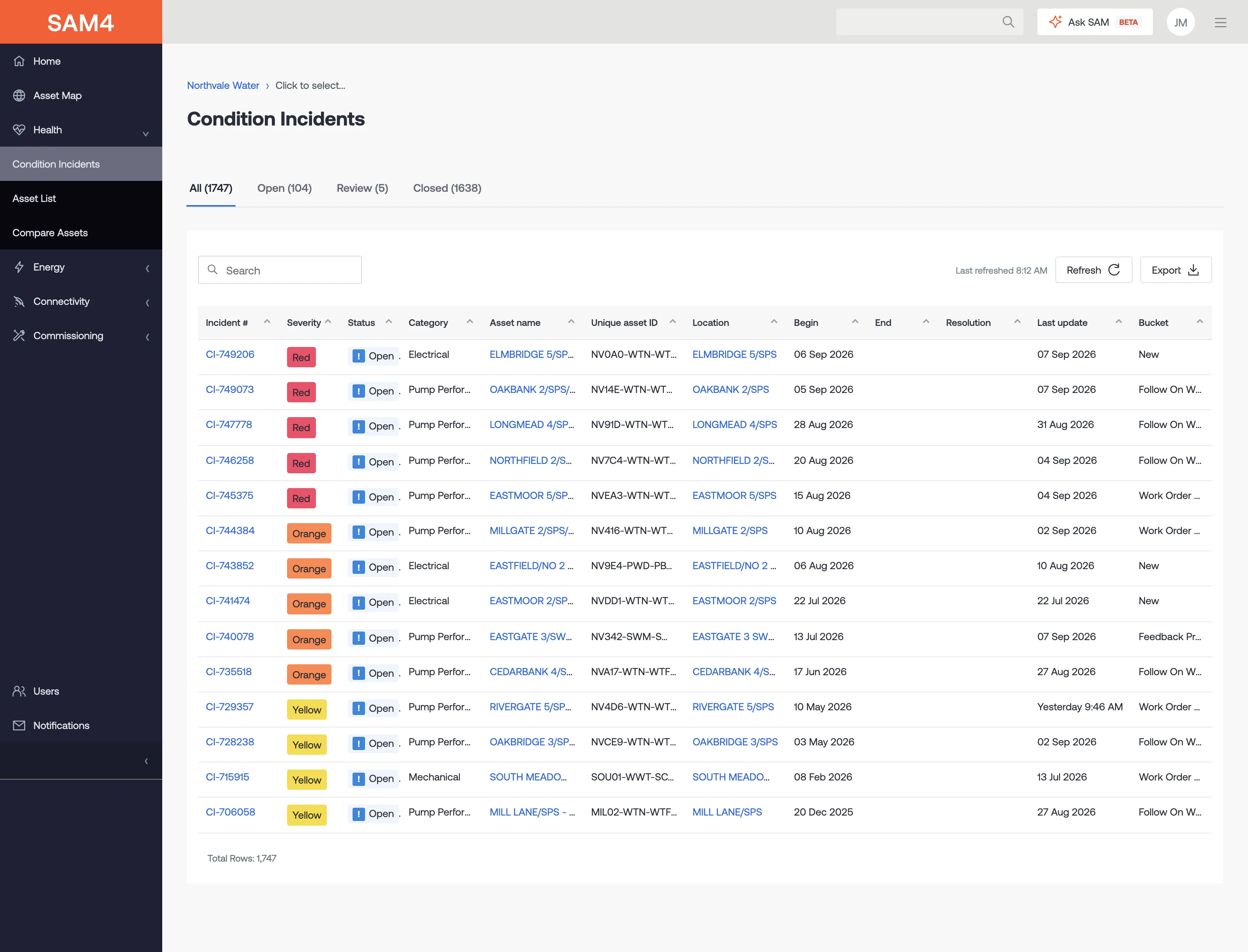
Start with the findings that need review. See each open finding, the asset involved and its fault type. Check how urgent it is, what has changed and whether follow-up work is still open.
Your next step: Choose which finding to check first.
A recommendation becomes a site decision
Your engineers choose the next step
In this illustrative incident, Samotics recommends an inspection. The site engineer chooses when and how to carry it out and records the plan.
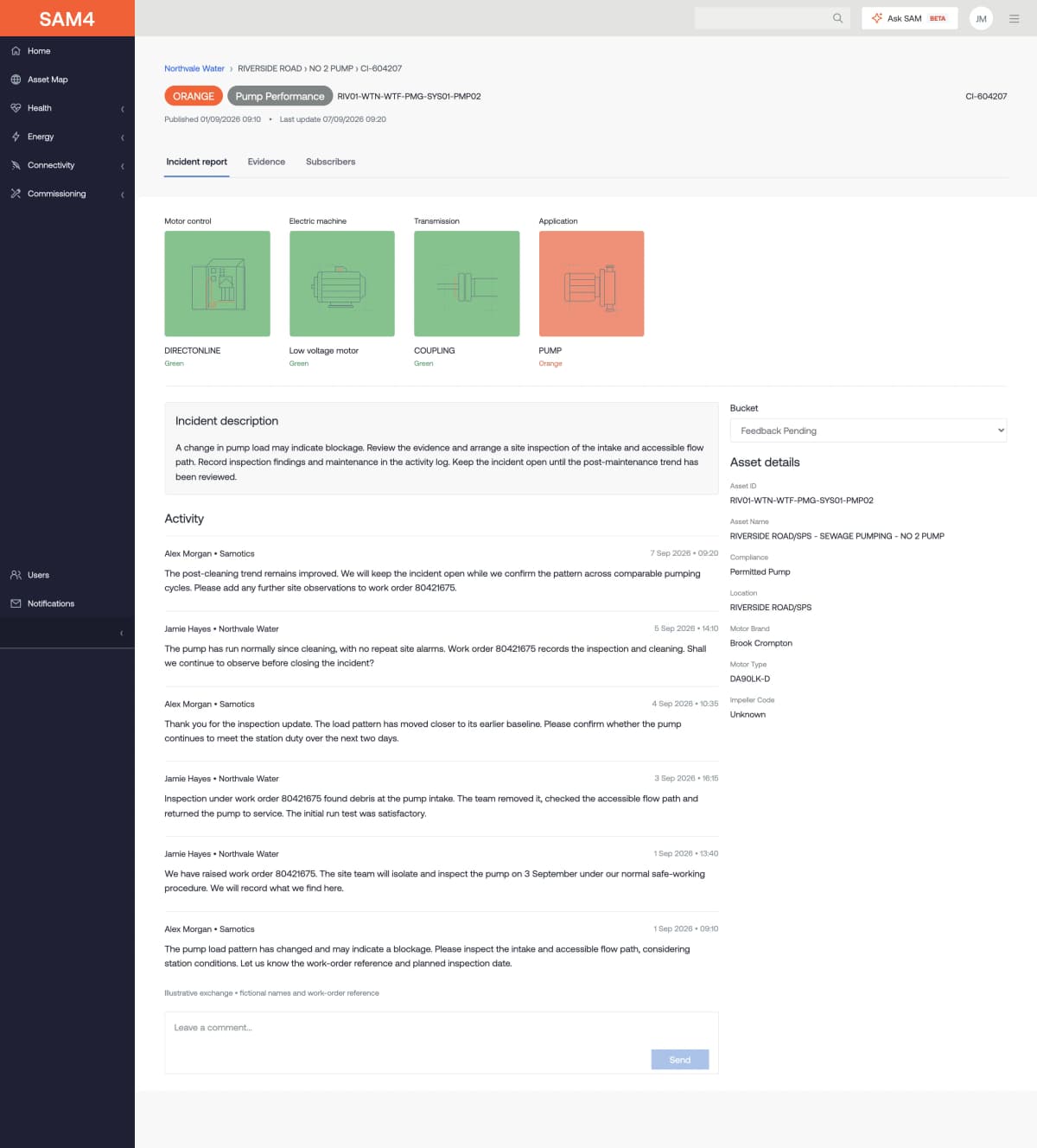
Site engineer · 1 September, 13:40
The site team will isolate and inspect the pump on 3 September under our normal safe-working procedure.
Samotics engineer · 1 September, 09:10
The pump load pattern has changed and may indicate a blockage. Please inspect the intake and accessible flow path, considering station conditions.
Samotics explains what to check
A changed pump-load pattern prompts a recommendation to inspect the intake and accessible flow path.
The site team decides how to act
The engineer raises a work order and schedules the inspection under the site’s safe-working procedure.
Read the exchange as text
Samotics engineer · 1 September, 09:10
The pump load pattern has changed and may indicate a blockage. Please inspect the intake and accessible flow path, considering station conditions. Let us know the work-order reference and planned inspection date.
Site engineer · 1 September, 13:40
We have raised work order 80421675. The site team will isolate and inspect the pump on 3 September under our normal safe-working procedure. We will record what we find here.
From measurement to the maintenance response
Measure
SAM4 captures current and voltage at the motor control cabinet. Three-phase waveforms are converted into the frequency domain.
You get: a high-resolution electrical signature for every monitored asset.
Detect
Models compare each asset against its own healthy baseline and known fault patterns from the monitored fleet.
You get: a flagged deviation with an initial fault hypothesis.
Diagnose
SAM4 identifies the likely fault type, drivetrain location, confidence, severity, and supporting spectral evidence.
You get: a diagnostic record your team can review.
Validate
Reliability engineers review ambiguous and edge-case findings before the customer is notified. Post-review false-alert rate: 2.1%.
You get: a validated alert, not a raw anomaly.
Recommend
Each alert includes a recommended next step: inspect, schedule maintenance, escalate or continue monitoring, with an assessment of urgency and supporting evidence.
You get: a specific recommendation and timeframe to assess alongside site conditions before deciding how to respond.
Integrate
Alerts route into your CMMS, email, dashboard or workflow tool. Resolution data feeds back into the model.
You get: findings in your existing maintenance workflow. Where configured, these populate a work order for your team to review and schedule.
Your team decides the maintenance response
Use the fault evidence, urgency and recommended action alongside site conditions to decide whether to inspect, plan maintenance or continue monitoring. Samotics provides diagnostic support as you assess the finding.
Engineering support for your maintenance decisions
Samotics provides fault assessments, supporting evidence and recommended next steps. Your team uses these alongside site conditions to decide how to respond.
SAM4 monitors connected assets continuously while they operate, using runtime, load and signal history to put changes in context. Samotics reliability engineers review ambiguous and high-impact findings before they become customer-facing alerts. Each alert includes the likely fault, severity, supporting evidence and a recommended next step.
Your engineers combine this assessment with operating conditions, maintenance history and the consequences of failure. They decide how to respond and when to act. Samotics provides the expert review and diagnostic support agreed for your service, helping your team understand the finding and assess the recommendation.
Samotics engineers are trained in electrical signature analysis, bearing diagnostics and drivetrain failure modes. They work across three regions to provide follow-the-sun coverage. Site inspection findings and maintenance outcomes feed back into the assessment.
Every reviewed alert improves the system. Validated faults, false alerts, customer confirmations, and resolved work orders feed back into SAM4's models and monitoring process. The dataset compounds across 7,000+ monitored assets and 80+ customers. The 2.1% post-review false-alert rate is calculated across 1,402 customer-facing detected and false-alert outcomes in the last 12 months.
SAM4 monitoring is distributed across Europe, Asia, and the Americas. When an urgent finding appears outside local working hours, the active monitoring region reviews and escalates it before the customer's next shift starts.
Trained in electrical signature analysis, motor diagnostics, drivetrain fault patterns, and load-path behaviour, the same engineers who train SAM4's detection models review your alerts.
Four checks before rollout
Before SAM4 goes live, we scope four things: the asset, the cabinet, the data path, and your maintenance workflow. That makes deployment predictable before hardware is installed.
Installation fit
< 60 minutes
to install per motor at the MCC
Split-core CTs and voltage taps are installed in the motor control cabinet. No asset-mounted sensors and no routine entry into wet, hazardous, or hard-to-reach areas.
Monitoring fit
Per-fleet scoping
asset, motor, drive, load, and failure modes reviewed
SAM4 is scoped against asset type, motor configuration, drive setup, operating profile, load stability, signal quality, and the fault modes you need to detect across direct electrical, drivetrain, and process or hydraulic load-path faults. Most three-phase induction motors above 1 kW are technically suitable, including many VFD-driven assets. Each fleet is reviewed before deployment.
Connection & workflow
SAP · Maximo · Infor
CMMS systems, native integration
SAM4 connects to the platform over a cellular path outside your IT/OT network. Validated findings push as structured work orders with fault type, severity, asset ID, evidence, and recommended action. No duplicate data entry.
Security review
ISO 27001 · 9001
independently audited by DNV
SAM4 uses a secure data path outside your IT/OT network. Data is encrypted in transit and at rest. Documentation is available for IT, security, procurement, and NIS2-aligned critical infrastructure reviews.
Evaluate SAM4 on your first assets
Most customers begin with 10 to 25 critical assets, prove value on site, then expand across assets and locations.
The first deployment is designed to build internal proof. You select assets where monitoring is difficult, failure is costly, or vibration access is impractical. SAM4 installs at the motor control cabinet, baselines normal behaviour, validates early findings, and gives your team evidence for the next rollout phase.
Choose the right first assets
Start with 10 to 25 critical motors or driven assets. Prioritise equipment with high downtime cost, poor monitoring coverage, repeated failures, or limited physical access.
Install without machine access
SAM4 installs at the motor control cabinet, usually in under 60 minutes per asset. No asset-mounted sensors. No routine access to wet, hazardous, submerged, or enclosed equipment.
Build proof from the first alerts
SAM4 baselines normal behaviour, detects developing faults, and validates ambiguous findings before notifying your team. Each alert includes fault evidence, severity, and a recommended next step.
Scale the same model
Once the first sites prove value, expand across assets, sites, and regions. The same platform, monitoring team, and workflow integrations scale with you.
Results from monitored sites
SAM4 is validated across real industrial fleets, customer-confirmed faults, and operational outcomes.
7,000+ monitored assets. 80+ customers.
SAM4 monitors rotating assets across water and wastewater, chemicals, oil and gas, metals and mining, pulp and paper, airports, and manufacturing.
Why it matters: the models learn from real operating conditions across diverse industries, not isolated lab tests.
95.5% recall on confirmed fault events.
Recall measures how many confirmed fault events SAM4 detected in time: 1,372 of 1,437 confirmed fault events, drawn from 2,087 reviewed events, 12 months ending 1 May 2026. Post-review false-alert rate: 2.1%. Reviewed quarterly.
Why it matters: high recall means fewer faults slip through. A low false-alert rate means your team can trust the system.
£10M+ estimated benefit at Yorkshire Water.
Yorkshire Water estimates benefit exceeding £10M across its SAM4 deployment. Contract awarded 2022.
DuPont
“We invested heavily in condition-based maintenance — vibration, oil analysis, airflow, the lot. But those approaches can still be snapshots. SAM4 added continuous visibility.”
John McCrystal, Reliability and Maintenance Specialist
Schiphol Airport
“SAM4 detected possible bearing damage to the gearbox motor, which we had not picked up through our vibration monitoring. Following the SAM4 alert, we found that the bearing had already degraded significantly. SAM4 had saved us from a costly unexpected failure.”
Yorkshire Water
“Critical in our monitoring of hard to reach assets such as submersible pumps. System works very well, support is also very good.”
Michael Horner
Common questions before a first deployment
Everything in one system: cabinet-installed measurement hardware, the analytics platform, the managed monitoring service with reliability-engineer review, and workflow integrations into your CMMS, email, or dashboard. There is no separate analytics licence or monitoring contract to assemble. Commercial structure is scoped per fleet during the intake conversation.
No. You do not need a dedicated ESA analyst to use SAM4. Each alert includes the likely fault, severity, supporting evidence and a recommended action. Samotics provides the expert review and support agreed for your service. Your team uses the assessment alongside its knowledge of the equipment to decide how to respond.
Four checks before rollout: the asset, the cabinet, the data path, and your maintenance workflow. Installation takes under 60 minutes per motor at the MCC, and detection starts at install; there is no multi-week training period. Most customers begin with 10 to 25 critical assets and expand after the first validated findings.
Usually very little. SAM4 connects over a cellular path outside your IT and OT network by default, with Ethernet as an alternative. Data is encrypted in transit and at rest, and Samotics is ISO 27001 and ISO 9001 certified, independently audited by DNV. A documentation pack is available for IT, security, and procurement reviews, including NIS2-aligned critical infrastructure assessments. See the security overview.
No. SAM4 works alongside vibration systems, SCADA, and maintenance planning tools; nothing gets replaced. It closes the monitoring gap around assets where mounted sensors are impractical, unsafe, or too expensive to maintain.
No monitoring system catches everything, so we publish the numbers: 95.5% recall on confirmed fault events and a 2.1% post-review false-alert rate, measured on a defined 12-month window and reviewed quarterly. Every miss and false alert is analysed and fed back into the models. If a site produces noisy alerts, we recalibrate the per-asset baselines rather than pass the noise on to your team.
SAM4 is built for three-phase AC motors and the equipment they drive; most induction motors above 1 kW are technically suitable, including many VFD-driven assets. Single-phase, DC, and servo motors are out of scope, as are assets without safe cabinet access or with too little operating time to build a baseline. Fit is confirmed per fleet before deployment. See where ESA fits best.
Start here
Begin with your most critical assets. Most customers start with 10 to 25 assets. Build confidence, then expand across more of the rotating assets your current monitoring programme does not cover.