
Chemicals & Process Industries
Condition monitoring in chemical plants
Monitor pumps, compressors and other motor-driven equipment from the motor control cabinet. SAM4 can cover suitable assets in hazardous or corrosive process areas where installing and maintaining sensors on the machine is difficult.

Trusted by leaders in chemicals and process industries





Monitoring equipment in hazardous and corrosive areas
Chemical production runs continuously, handles hazardous materials, and operates under strict process-safety and environmental obligations. Equipment failure does not just cost money. It triggers regulatory investigation.
What chemical plants face every day
Continuous process
24/7 production. Turnarounds happen once a year at best. No window to retrofit sensors mid-campaign.
Hazardous and corrosive zones
ATEX certification, Hastelloy upgrades, and corrosion shorten the life of every mounted sensor.
Compliance pressure
Seveso III, COMAH, and OSHA PSM each demand documented mechanical-integrity evidence.
Gaps in chemical-plant monitoring
Vibration covers a fraction
Mounted sensors are economic for the largest, most accessible assets. The rest run uninstrumented.
Sensors do not survive
Sensor maintenance and replacement become part of the problem in corrosive environments.
Most assets run dark
Reactor vessels, scrubbers, and ancillary drives run without continuous condition data.
Mission-critical chemical assets run without continuous condition data, in environments where mounted sensors fail or cannot scale.
Read motor current from outside the ATEX zone.
When the MCC is outside the classified area, SAM4 reads motor current at the control cabinet without placing a sensor inside the hazardous area. SAM4 detects mechanical and electrical faults in the driven equipment based on the electrical signal.
Avoid asset-mounted sensors in the ATEX zone
When the MCC is outside the classified area, SAM4 avoids asset-mounted sensors in the ATEX zone. Site permitting and cabinet-access procedures still apply. The measurement happens at the electrical supply, not the mechanical asset.
Brief MCC outage per asset
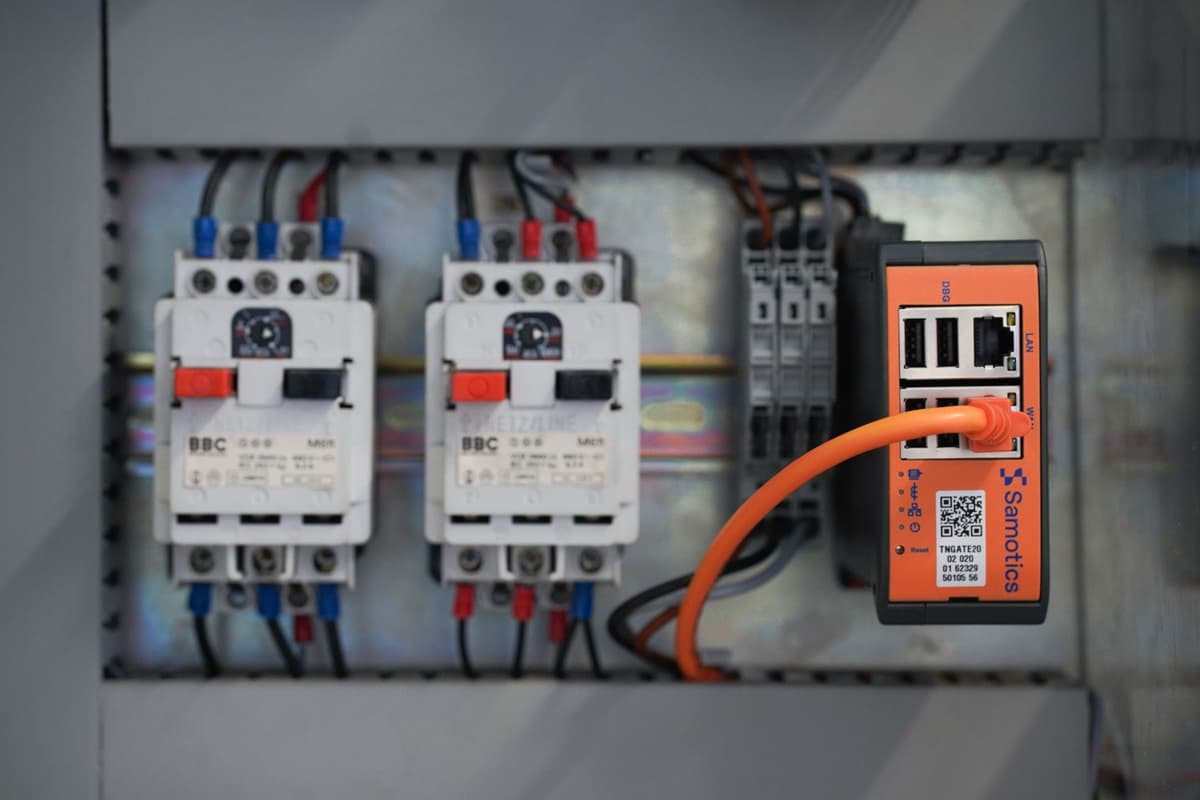
Current transformers clip around the phase wires inside the MCC. Installation usually takes under 60 minutes per asset, including a brief de-energisation. No process-floor sensor installation. Installation is planned at the MCC and usually requires only a short cabinet intervention.
Cover more of the motor-driven fleet from one cabinet
SAM4 can cover many AC-motor-driven pumps, agitators, fans, blowers, compressors, and conveyors. Fit depends on motor configuration, duty cycle, load behaviour, and the failure modes you need to detect. Monitor more of the fleet from the MCC room, not individual assets scattered across hazardous zones.
Detects mechanical, electrical, and some process-induced anomalies
SAM4 can detect bearing degradation, belt wear, cavitation, imbalance, winding issues, and some process-induced anomalies where the operating problem changes current, voltage, torque, speed, or load. It does not detect every process fault. Examples include a product pump cavitating because of incorrect startup procedures, or an agitator running at a suboptimal speed.
“With SAM4, we stopped guessing. We had continuous visibility instead of a monthly snapshot.”
The equipment behind your process
SAM4 monitors any AC motor-driven rotating equipment from the motor control cabinet. In chemicals, these are the asset types where unplanned failure creates the highest safety, production, and compliance risk. See all monitored assets

Pumps
Centrifugal pumps in water, chemicals, oil & gas, and process industries.

Agitators & mixers
Reactor agitators, tank mixers, and blenders.

Fans & blowers
Ventilation fans, cooling fans, process blowers, and aerators.

Conveyors
Belt conveyors, screw conveyors, and chain drives.
Detections at chemical production sites
Condition monitoring for anolyte pumps: a case study
Read how SAM4 saved this chemical manufacturer 15 thousand euros by detecting cavitation-induced pump damage.

Condition monitoring for circulator pumps: a case study
Read how SAM4 caught misalignment between this pump's gearbox and motor 7 months in advance for a chemical customer.

Preventing downtime on belt-driven equipment
Belt wear rarely shows on a vibration route until it is advanced. SAM4 reads belt-pass frequency at the cabinet and flags the drift weeks earlier.
From alert to planned repair
Reliability teams use SAM4 findings to decide what to inspect and when to schedule the work.
Alert classified
SAM4 detects a developing fault and classifies it by asset, fault type, severity, and recommended action. Your reliability engineer sees what is wrong before walking to the plant floor.
Engineer reviews and decides
The engineer reviews the alert, checks the SAM4 dashboard for trend data, and decides whether to repair at the next turnaround or act sooner. The data tells you before you touch the asset.
Planned repair, not emergency shutdown
Parts are ordered. The crew is scheduled. The repair happens in a planned window. Earlier detection reduces the chance that a maintenance issue turns into an emergency intervention or reportable incident.
Captured for audit and compliance
Each alert, maintenance action, and outcome is recorded. The audit trail supports OSHA PSM mechanical integrity, Seveso III Safety Management Systems, and COMAH condition-based maintenance.
Across DuPont's deployment, that workflow added up to €1.7M in prevented costs.
"It was great to get this insight so early, before it caused any damage and all we had to do was put in a new bolt."
John McCrystalReliability and Maintenance Specialist, DuPont
No sensors in the ATEX zone
Clip on at the MCC
Current transformers clip around the phase wires inside the motor control cabinet. When the MCC sits outside the hazardous area, no asset-mounted ATEX sensor is required. Brief MCC outage; under 60 minutes per motor in typical configurations. Site permitting and cabinet-access procedures still apply.
Connect via cellular or Ethernet
Data transmits over 4G/5G or local network. Cellular deployments can avoid firewall and VPN changes. Store-and-forward buffering handles connectivity gaps. SAM4 is monitoring-only and does not send control commands to the operational network.
Monitor from anywhere
Authorised users can access the SAM4 dashboard from approved devices and locations. Alerts route to email, your CMMS, or your control room. Works alongside existing vibration programmes and SCADA.
Where SAM4 fits, and where it needs review
SAM4 is strongest where the monitored asset is AC-motor-driven, the electrical signal is accessible at the MCC or VFD, and the failure modes create measurable changes in current, voltage, torque, speed, or load. Fit depends on motor configuration, drive topology, duty cycle, load stability, operating regime, and the failure modes you want to detect. During asset-fit review, we identify which assets are strong candidates, which need engineering review, and which are better covered by vibration, process instrumentation, OEM monitoring, or inspection.
The questions chemical engineers actually ask
No. SAM4 hardware installs inside the motor control cabinet, which sits outside the ATEX zone. No sensor enters the hazardous area. No ATEX certification is needed for the monitoring equipment. No confined space entry. No ignition sources near explosive atmospheres. This is the core advantage of cabinet-based ESA monitoring in chemical plants.
Seveso III and COMAH explicitly recognise condition-based maintenance as a valid strategy for monitoring ageing equipment and preventing major accident hazards. SAM4 provides continuous condition data with a documented audit trail: every alert, every maintenance action, every outcome. That documentation directly supports your Safety Management System obligations and OSHA PSM mechanical integrity requirements.
Yes. SAM4 is highly compatible with variable frequency drives. VFDs are increasingly common in chemical production for process control and energy savings. SAM4 monitors VFD-driven motors from the MCC using the same clip-on installation. The cavitation detection on the 200 kW product pump described above was on a VFD-controlled asset.
No. SAM4 complements vibration, it does not replace it. On assets where vibration sensors are already installed and working, ESA adds electrical fault detection, energy data, and process insights that vibration cannot see. On the rest of your fleet, the assets in ATEX zones, corrosive environments, or simply too numerous to justify vibration routes, SAM4 is the primary condition monitoring source. DuPont ran both programmes in parallel.
ESA detects bearing degradation, mechanical imbalance, belt wear, cavitation, coupling faults, motor winding issues, and grid-level electrical faults. It also detects process-induced issues like incorrect operating procedures. It does not detect mechanical seal degradation on pumps, internal valve faults on compressors, or screw element leakage. We state these limitations upfront because honesty about detection boundaries builds more trust than overclaiming.
None. SAM4 builds its own baseline from live electrical measurements starting at installation. Within weeks, it has enough data to detect anomalies. No historical data export, no SCADA integration, and no process historian connection is required to begin. DuPont had their first detection within the initial deployment period.
At $650,000 per hour of unplanned downtime in chemicals, a single avoided production stop can pay for a multi-year deployment. DuPont prevented €1.7M in costs across 15+ detections. A single belt misalignment detection on an exhaust fan avoided €170,000. The payback depends on your downtime cost, fleet size, and current failure rate. We provide a plant assessment that models the expected return for your specific operation.
SAM4 is monitoring-only. It reads electrical signals passively. It has no connection to control systems and cannot send commands to any asset. Data transmits over cellular or a dedicated network, completely separate from the operational network. No IT/OT convergence is required. No DCS integration. No process historian write access.
Prioritise hazardous-zone assets without mounting sensors on the machine.
Start with pumps, agitators, fans, blowers, compressors, and other AC-motor-driven assets where access, certification, or corrosion limits current monitoring coverage.