
CONDITION MONITORING FROM THE CABINET
Understand developing faults. Decide what happens next.
SAM4 monitors motor-driven equipment from the electrical cabinet. You receive a diagnosis, supporting evidence and a recommended action. Your engineers decide how and when to respond.
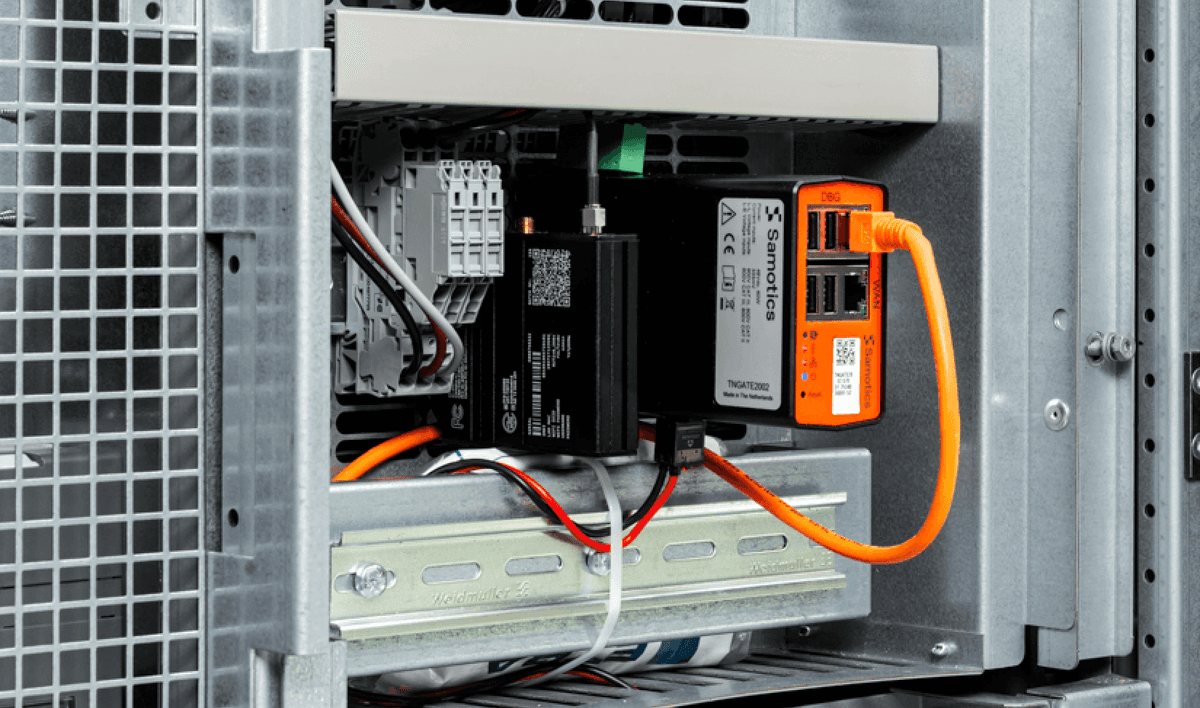

Strategic technology partner
Samotics ESA, embedded in ABB drives.
ESA-enabled ABB drives supply the electrical measurements. SAM4 turns those signals into insight into the condition of your equipment.
Meet SAM4
Hardware. Analytics. Monitoring service.
SAM4 monitors motor-driven equipment from the electrical cabinet. You review findings and supporting evidence in the SAM4 dashboard.
Cabinet measurements
SAM4 hardware or a compatible ESA-enabled ABB drive.
Analytics
Detects developing fault patterns.
Monitoring service
Samotics assesses findings and recommends next steps.
Illustrative pattern over time
Your finding in SAM4
Likely fault and urgency.
Recommended next step.
Evidence you can inspect.
You decide the response, with Samotics’ diagnostic support.
Inspect, plan maintenance or continue monitoring.
Customer results
Named customers, quantified outcomes, and independent verification where available.
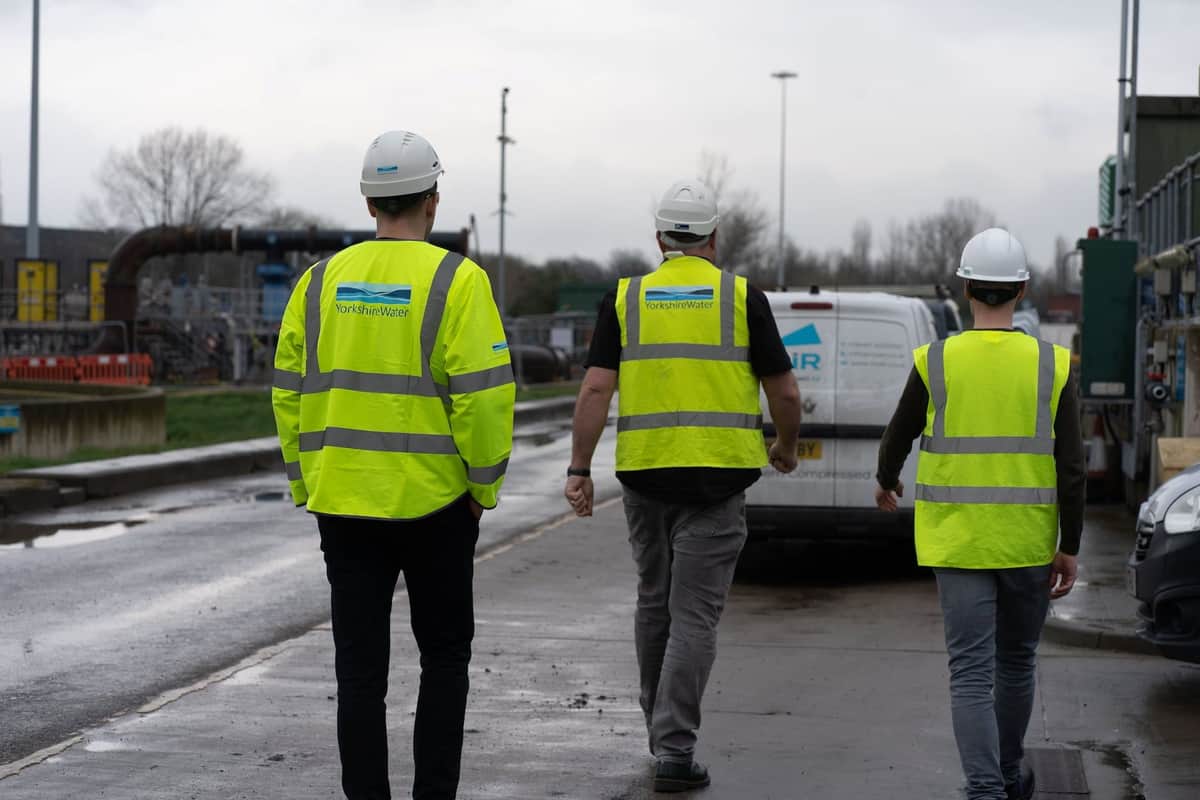
Yorkshire Water
£10M+ estimated benefit across the deployment, per Yorkshire Water's own analysis. Contract awarded 2022.
4,000+ pumps monitored from the electrical panel. 15% of inspection trips replaced per year. Submerged pumps that mounted vibration sensors could not practically cover became part of a continuous monitoring programme.

Nyrstar
800% ROI in 11 months.
Zinc smelter assets monitored from the motor control cabinet, without placing sensors in the harsh process environment. SAM4 detected 7 developing faults before failure, including a damaged 10 kV rectifier cable that would have caused more than €1M in equipment damage.

Schiphol Airport
9 of 9 known failures detected, including bearing damage that vibration monitoring did not pick up.
Baggage handling motors monitored continuously across a 12-month trial.
“SAM4 detected possible bearing damage to the gearbox motor, which we had not picked up through our vibration monitoring.”
Need to validate the claims with a peer? Ask us for a relevant customer reference for your asset type or industry. See all customer results · Request a customer reference
Using SAM4 findings to plan maintenance
Start with fleet priorities, open a machine and review the evidence behind a finding. Explore the SAM4 views that support your next maintenance decision.
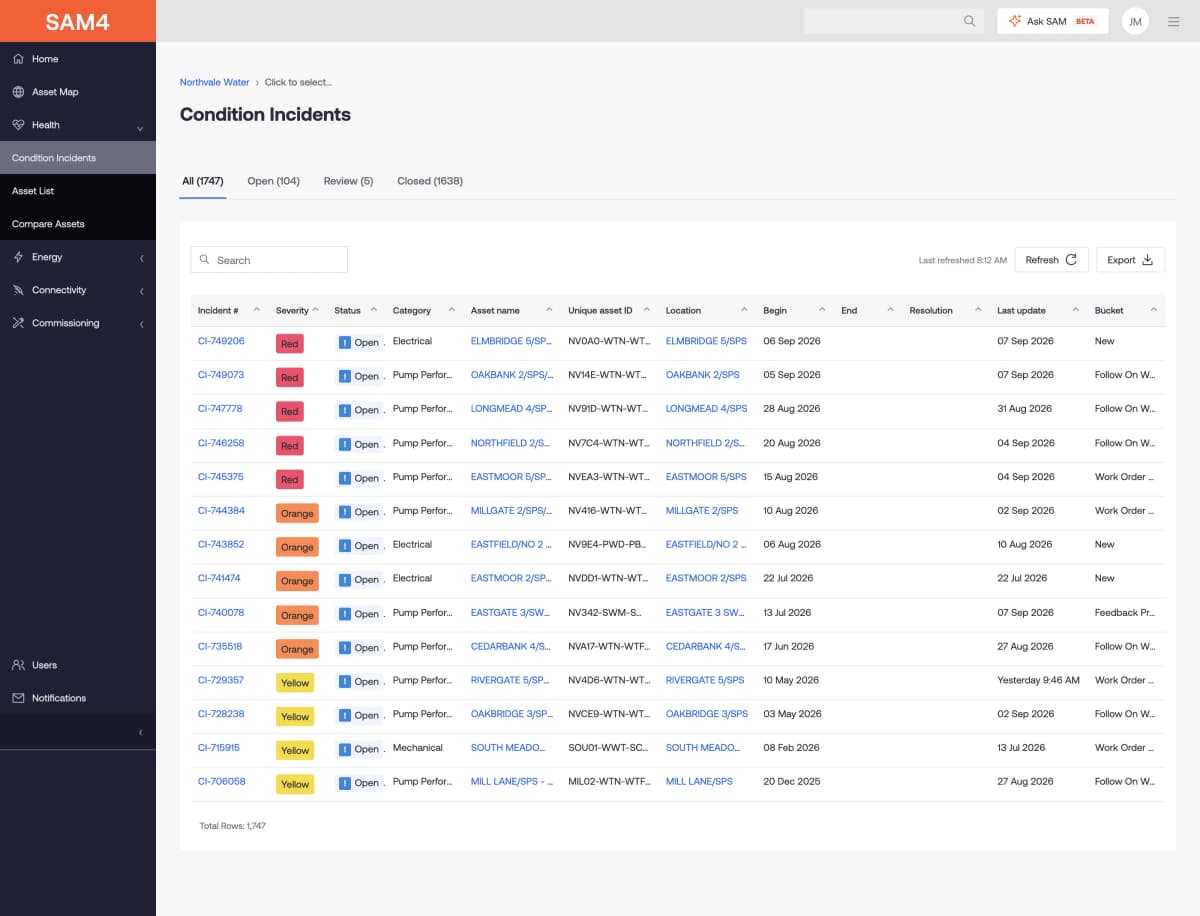
Explore the SAM4 product tour →Machine condition →Incident evidence →Energy performance →
Detection performance you can inspect
95.5% recall on confirmed fault events. 2.1% post-review false-alert rate. From 2,087 reviewed events in the last 12 months: recall scored on 1,437 confirmed fault events, false-alert rate on 1,402 customer-facing alerts. Performance varies by asset type, fault mode, operating profile, and data quality.
Plan the next maintenance step
Use the diagnosis and recommended action alongside your plant knowledge. Discuss uncertain findings with Samotics and choose the inspection or maintenance response.
Close the gaps between inspections
Submerged pumps, enclosed drives and hazardous-zone motors can be difficult to instrument. Access may require specialist permits, lifting equipment or a planned stop. Periodic inspections leave gaps between checks.
“In the steel industry, assets frequently operate in conditions that are not hospitable to sensitive sensor technologies. The conveyors at our hot strip mill are a critical part of the production process, but it's virtually impossible to use manual or vibration-based techniques to assess their condition.”
Monitor equipment from the electrical cabinet
SAM4 measures three-phase current and voltage at the motor control cabinet. Electrical Signature Analysis (ESA) looks for patterns linked to faults in the motor, drivetrain or driven equipment.
Detection depends on the fault producing a measurable signal under the asset's operating conditions.
Install at the cabinet
Measurement hardware at the MCC
Capture the signal
Three-phase current and voltage
Analyse the patterns
ESA and asset context
Review the finding
Engineer review where needed
Route to action
Evidence and a recommended next step
Your team decides the maintenance response.
SAM4 works alongside vibration monitoring, SCADA and maintenance tools.
The assets SAM4 monitors.

Agitators & mixers
Archimedes screws
Canned motor pumps
Compressors

Conveyors

ESPs
ESPs

Fans & blowers
LV motors
MV motors
Pumps
Rising mains
Submerged Sewage Pumps
Transmissions
Plan monitoring with your team
SAM4 combines cabinet measurements, cloud analysis and the monitoring service agreed for your assets.
Samotics supplies the assessment
Samotics reviews ambiguous findings and provides a diagnosis, supporting evidence and a recommended next step. Your team brings the plant knowledge and decides how to respond.
Scope the first deployment
Review the assets, cabinets, connectivity and maintenance workflow before installation. Agree site access, responsibilities and success criteria for the first deployment.
Prepare the IT review
Cellular monitoring can use a data path separate from your IT and OT networks. Deployment still follows your site’s IT, security and approval requirements.
Common questions
ESA reads current and voltage waveforms at the motor control cabinet. SAM4 analyses those signals to detect patterns linked to electrical, mechanical, and operational faults across the motor-driven system.
It can also track load, operating behaviour, efficiency losses, and performance drift. No sensors are mounted on the machine.
SAM4 monitors AC-motor-driven assets such as pumps, fans, compressors, conveyors, transmissions, ESPs, mixers, and motors. Suitability depends on motor type, load profile, operating behaviour, drivetrain configuration, and the fault modes you need to detect. That is why we start with an asset fit review.
Installation typically takes under 60 minutes per asset once cabinet access and safe-working approval are in place. Split-core current transformers clip onto existing cables in the motor control cabinet. Voltage connections require a short de-energisation at the cabinet. No field access to the asset is required.
Installation is fast, but useful monitoring depends on asset fit, operating data, correct configuration, and clear success criteria. The asset fit review covers all four before deployment.
ROI depends on asset criticality, failure rate, downtime cost, inspection effort, and deployment scale. The strongest evidence is customer-reported.
Yorkshire Water estimates benefit exceeding £10M across its deployment. DuPont has prevented €1.7M in costs across 15+ detections. During a 12-month pilot SAM4 detected 12 of 12 developing faults at ArcelorMittal; after rollout to 56 runout-table rollers, a further 27 detections saved an estimated 31 hours of downtime.
SAM4 integrates through REST API or MQTT. Common integrations include SAP PM, IBM Maximo, and other CMMS platforms. Diagnostic reports can be pushed into your existing work order flow, so teams can act inside the systems they already use.
Vibration monitoring provides strong diagnostics on accessible assets where sensors can be mounted close to the machine. SAM4 uses electrical signature analysis to monitor from the motor control cabinet. That makes it useful for assets where mounted sensors are difficult, unsafe, expensive, or impractical: submerged pumps, enclosed drives, hazardous-zone motors, rooftop fans, and distributed fleets.
The two methods are complementary. SAM4 does not replace vibration everywhere. It fills the monitoring gap where access-dependent methods struggle.
SAM4 scores detections by severity, urgency, and confidence. Ambiguous and edge-case detections are reviewed by Samotics reliability engineers before they reach your team. Post-review false-alert rate is 2.1%. Every customer-facing alert includes a diagnosis, severity assessment, supporting evidence, and a recommended action.
Find the assets your current sensors do not cover.
Discuss the assets you need to monitor, the faults you want to detect and the practical requirements for deployment.