
Oil & Gas
Condition monitoring for oil and gas
SAM4 uses electrical measurements at the cabinet to monitor suitable motors and driven equipment. Applications include ESPs and equipment in hazardous areas. Asset configuration, measurement access and connectivity are reviewed before deployment.

Read motor current from the surface VFD.
SAM4 reads motor current at the control cabinet and detects mechanical, electrical, and operational faults in the driven equipment when the fault changes the electrical signature. In validated configurations, fault-relevant electrical signatures can be detected from surface measurements, including across VFD and cable-chain setups. No sensor enters the hazardous area. No hardware goes downhole.
Avoid asset-mounted sensors in the ATEX zone
When the MCC is outside the classified area, SAM4 avoids asset-mounted sensors in the ATEX zone. Site permitting and cabinet-access procedures still apply. The measurement happens at the electrical supply, not the mechanical asset.
No hardware downhole
For ESPs, SAM4 reads the motor current at the surface VFD. In validated configurations, the electrical signature carries information about rotor condition, cable health, gas lock events, and mechanical unbalance through the cable and transformer chain. No hardware goes downhole. Where downhole gauges degrade or fail, SAM4 can help maintain condition visibility from the surface. Workover timing remains an operator decision based on production, risk, and asset condition.
Edge analytics for bandwidth-constrained sites
SAM4 processes high-frequency electrical data at the edge. Only diagnostic results and alerts transmit to the cloud. Total data footprint: approximately 2 GB per month per site. That works on satellite, cellular, or low-bandwidth offshore networks where streaming raw vibration data does not.
Self-adapting baselines
SAM4 builds baselines from live electrical measurements and adapts as operating regimes change. The time required depends on runtime, load variability, and operating pattern stability. ESP wells cycling between production and gas lock resolve automatically without manual rebaselining.
Exception-based surveillance across the field
A production engineer managing 50 ESPs cannot watch every well in real time. SAM4 runs exception-based surveillance across the full fleet. It flags the wells that need attention and ranks them by severity. The engineer focuses on the exceptions, not the dashboards. That is how field-level operations work today with downhole data. SAM4 delivers the same operating model from the surface.
Monitoring gaps downhole, topside and offshore
The assets that cost most when they fail are the assets current monitoring cannot reach.
Downhole ESPs
Electric Submersible Pumps operate 1 to 3 km below the surface at 150°C and 300 bar. Pressure and temperature gauges sit at the pump.
Downhole pressure and temperature gauges are expensive to install and often degrade within months. When the gauge dies, the operator is blind. Pulling the string to replace it costs $1 to $2 million onshore and exceeds $7 million offshore.
Topside ATEX zones
Pumps, compressors, and fans on production platforms and refineries operate in explosive atmosphere zones (Zone 1 and Zone 2).
ATEX-certified vibration sensors require certification, cabling, inspection, and maintenance. The per-asset business case rarely closes. Most assets stay unmonitored.
Offshore platforms and remote wellpads
Production runs on satellite or limited cellular connectivity. Maintenance teams run lean, often hundreds of kilometres apart.
High-frequency vibration data demands bandwidth the link cannot carry. Operators settle for weekly snapshots. Failures go undetected between visits.
Oil and gas assets to assess
SAM4 can monitor many AC-motor-driven topside and downhole-lift assets where the relevant electrical signal is available at the MCC or VFD. In oil and gas, that spans three distinct operating environments, each with its own monitoring constraint that SAM4 addresses.
Peer-reviewed field results. Named detections.

Condition monitoring for oil transfer pumps: a case study
Read how SAM4 spotted coupling, vane and foundation issues in time to avoid pump failure for this tank storage customer.

Identifying and fixing a broken sine wave filter in electric submersible pumps
Recurring ESP problems had no obvious cause. Irregular harmonic and voltage patterns at the surface VFD traced them to a failed sine wave filter.
No sensors in the ATEX zone. No hardware downhole.
Clip on at the MCC or VFD
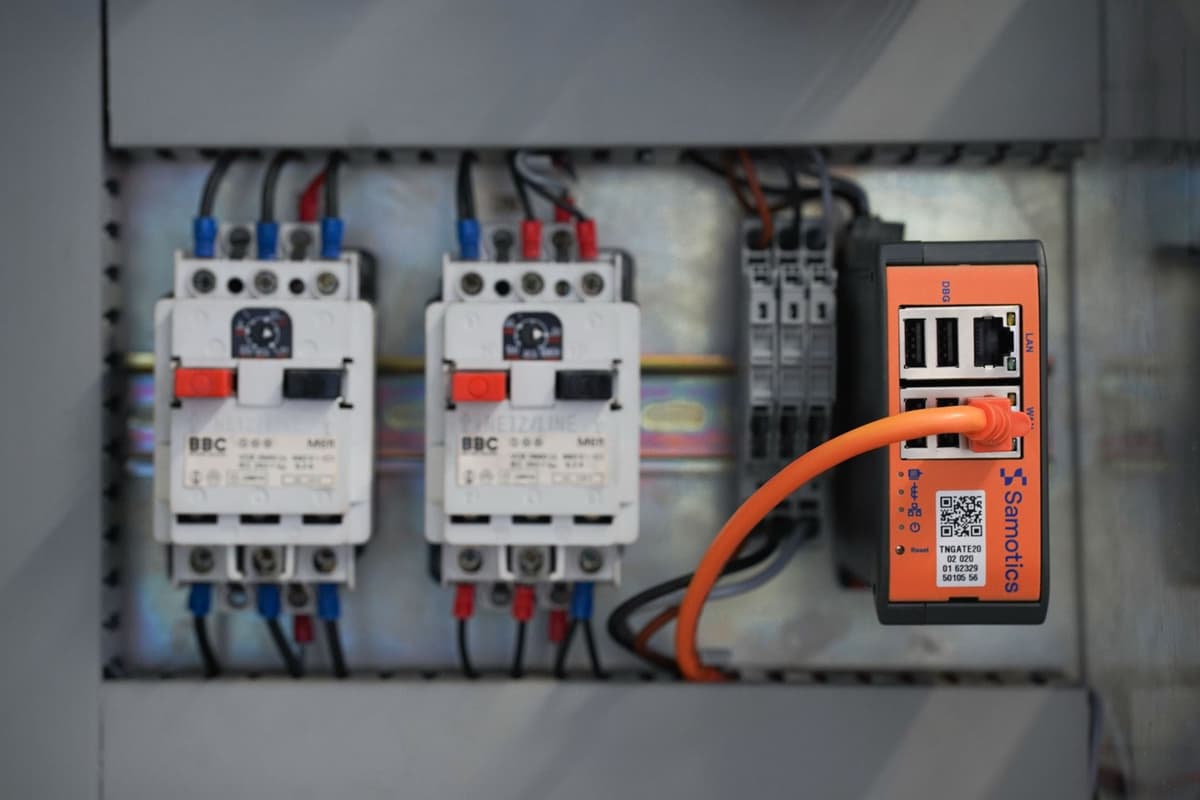
Current transformers clip around the phase wires inside the motor control cabinet or VFD. When the cabinet sits outside the hazardous area, no asset-mounted ATEX sensor is required. No downhole intervention. Brief MCC outage; under 60 minutes per motor in typical configurations. Site permitting and cabinet-access procedures still apply. For ESPs, the install happens at the surface VFD panel.
Connect via cellular, satellite, or Ethernet
Data transmits over 4G/5G, satellite, or local network. Edge processing reduces the data footprint to approximately 2 GB per month. Cellular deployments can avoid firewall and VPN changes. Store-and-forward buffering handles connectivity gaps on remote wellpads and offshore platforms.
Monitor from anywhere
Authorised users can access the SAM4 dashboard from approved devices and locations. Alerts route to email, your CMMS, or your control room. Works alongside existing vibration programmes and SCADA systems.
From alert to planned intervention
Detection matters only if it changes what your team does next. Here is how operations teams use SAM4 to stop running to failure and start planning.
Alert
Email lands with fault classification
Asset name, fault type, severity, recommended action. Orange means developing: plan the intervention. Red means imminent: act now. The production engineer sees the exception in the morning call, not after the VFD trips.
Validate
Engineer reviews trend, decides to act
The production engineer compares the SAM4 trend with available downhole data, production needs and operating risk, then decides whether to keep running, change the load or plan a workover.
Plan
Planned workover, not reactive scramble
Rig contracted. Replacement ESP on site. The workover happens in a planned window. A 1 to 6 month rig mobilisation scramble becomes a scheduled operation. Topside, planned maintenance replaces emergency shutdowns in ATEX zones.
Document
Compliance built into the audit trail
Every alert, every maintenance action, every outcome is recorded. That documentation supports OSHA PSM mechanical integrity, COMAH Safety Management Systems, and Seveso III condition-based maintenance obligations. The audit trail exists by default, not as an afterthought.
At the Permian Basin pilot (SPE-229389-MS), this workflow ran across 20 ESPs for 8 months of continuous operation.
The questions oil and gas engineers actually ask
Yes. The Permian Basin pilot (SPE-229389-MS) confirmed that electrical signatures carry fault-relevant information through the full cable and transformer chain between the surface VFD and the downhole motor. SAM4 detected four distinct fault categories through this path: sine-wave filter degradation, cable plug failures, mechanical unbalance, and gas locking. The signal is preserved because ESA analyses frequency-domain patterns, not raw amplitude, so cable-length attenuation does not degrade the diagnostic signal.
Yes. SAM4 is highly compatible with variable frequency drives. Most ESP installations use VFDs. All 20 ESPs in the Permian Basin pilot were VFD-driven. SAM4 monitors VFD-driven motors from the MCC or the VFD cabinet using the same clip-on installation. The system handles variable speed, variable load, and cycling operations without manual rebaselining.
Approximately 2 GB per month per site. SAM4 processes high-frequency electrical data at the edge. Only diagnostic results, alerts, and summary features transmit to the cloud. Raw waveform data stays local unless specifically requested for deep analysis. This footprint works on satellite, cellular, or bandwidth-constrained offshore networks.
No. SAM4 hardware installs inside the motor control cabinet, which sits outside the ATEX zone. No sensor enters the hazardous area. No ATEX certification is needed for the monitoring equipment. No confined space entry. No ignition sources near explosive atmospheres. This is the core advantage of cabinet-based monitoring in oil and gas.
No. SAM4 complements vibration, it does not replace it. On assets where vibration sensors are already installed and working, ESA adds electrical fault detection, energy data, and process insights that vibration cannot see. On the rest of your fleet, the assets in ATEX zones, on remote wellpads, or simply too numerous to justify vibration routes, SAM4 is the primary condition monitoring source. For ESPs and seawater lift pumps, SAM4 monitors assets that vibration cannot reach at all.
On ESPs, ESA detects sine-wave filter degradation, cable and cable plug failures, motor winding issues, rotor unbalance, and operational issues like gas locking and excessive cycling. It does not detect tubing leaks, formation sand production, or scale buildup inside the pump stages. We state these limitations because honesty about detection boundaries builds more trust than overclaiming. The SPE paper (229389-MS) documents both detections and limitations.
OSHA PSM mandates mechanical integrity testing for process equipment. Seveso III and COMAH require Safety Management Systems that include strategies for monitoring ageing equipment. SAM4 provides continuous condition data with a documented audit trail: every alert, every maintenance action, every outcome. That documentation directly supports your mechanical integrity programme and your Safety Management System obligations.
Today, when the downhole pressure and temperature gauge fails, the operator goes blind. The standard response is to run the pump to failure or pull the string to replace the gauge, at $1 to $2 million per workover onshore. SAM4 changes this. Because it monitors from the surface VFD, it is unaffected by downhole gauge failure. The ESP stays visible. That can extend the interval between workovers by 3 to 6 months of continued production.
Where SAM4 fits, and where it needs review
SAM4 is strongest where the monitored asset is AC-motor-driven, the electrical signal is accessible at the MCC or VFD, and the failure modes create measurable changes in current, voltage, torque, speed, or load. Fit depends on motor configuration, drive topology, duty cycle, load stability, operating regime, and the failure modes you want to detect. During asset-fit review, we identify which assets are strong candidates, which need engineering review, and which are better covered by vibration, process instrumentation, OEM monitoring, or inspection.
Monitor selected high-risk assets from the surface or safe-side cabinet.
Start with ESPs, hazardous-zone pumps, compressors, fans, and auxiliary drives where access, certification, or downhole hardware limits condition visibility.