
Submerged sewage pumps
Submerged sewage pump monitoring
SAM4 detects signs of ragging and blockage from electrical measurements at the motor control cabinet. The data helps your team decide which pump to inspect and when to attend the site.
Pumping stations are now a board issue
The Water (Special Measures) Act 2025 has made pollution a governance issue. Submerged pumping stations sit at the centre of that exposure: critical, distributed, and largely unmonitored.
The blockage problem
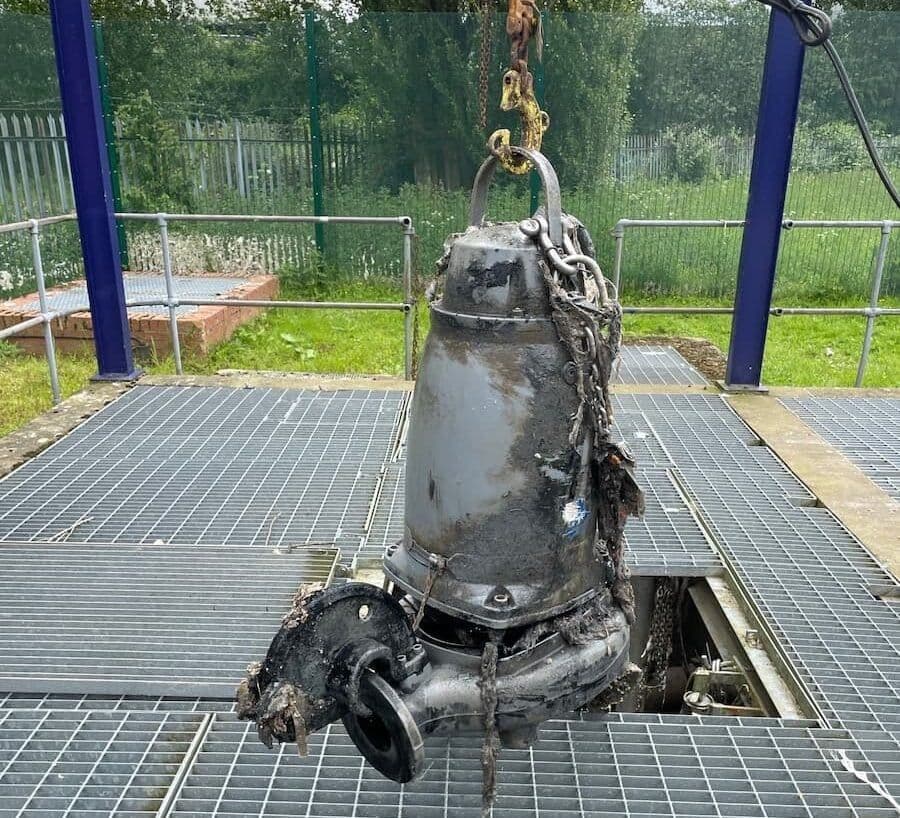
Rags, wet wipes, and debris cause the majority of sewage pump failures. Ragging incidents have risen sharply as disposable wipe use has grown. Progressive rag wrapping goes undetected by telemetry until the motor stalls or trips.
The telemetry lag
SCADA and telemetry do their job: levels, flow, run status, alarms. They catch faults at the moment of failure, when the pump trips or the wet well overflows. Slow rag build, developing cavitation, and gradual bearing wear give no telemetry signal until they cause the event. Telemetry is a lagging indicator. With personal director liability and multi-million pound pollution fines now on the table, lagging is not enough.
The access barrier
Submerged sewage pumps sit 3-10 metres below ground in sealed wet wells. Mounting and maintaining vibration sensors there is impractical at fleet scale. Pulling a pump to assess it is a confined-space operation costing £5,000 to £15,000 per event, often out of hours, often at 2am after a trip. Telemetry tells you it stopped, not that it was about to.
“Critical in our monitoring of hard to reach assets such as submersible pumps.”
Reading the pump from above ground
The motor cable already carries the diagnostic signal. SAM4 reads at the cabinet, classifies the fault, and routes it through expert review before it reaches you.
Many mechanical, electrical, and hydraulic changes on a submerged sewage pump create measurable changes in current, voltage, or load pattern. Ragging shifts the load profile. A failing impeller modulates the torque. Phase imbalance distorts the current waveform. Air lock changes the operating point.
These changes propagate up the motor cable to the motor control cabinet. SAM4 reads the three current and three voltage signals at the cabinet, sampled at the rate needed to resolve the fault frequencies of interest. No sensor enters the wet well. No personnel access is needed. The pump runs as it always has.
For submerged sewage pumps, this is the only practical path. The asset is sealed. The wet well is a confined space. Mounting and maintaining vibration sensors at scale is uneconomic, and on the worst-affected pumps it isn't possible at all. The cable is already there.
For a wider view of the approach, our sensorless pump monitoring guide explains what “sensorless” means, how performance is estimated, and where additional instrumentation is needed.
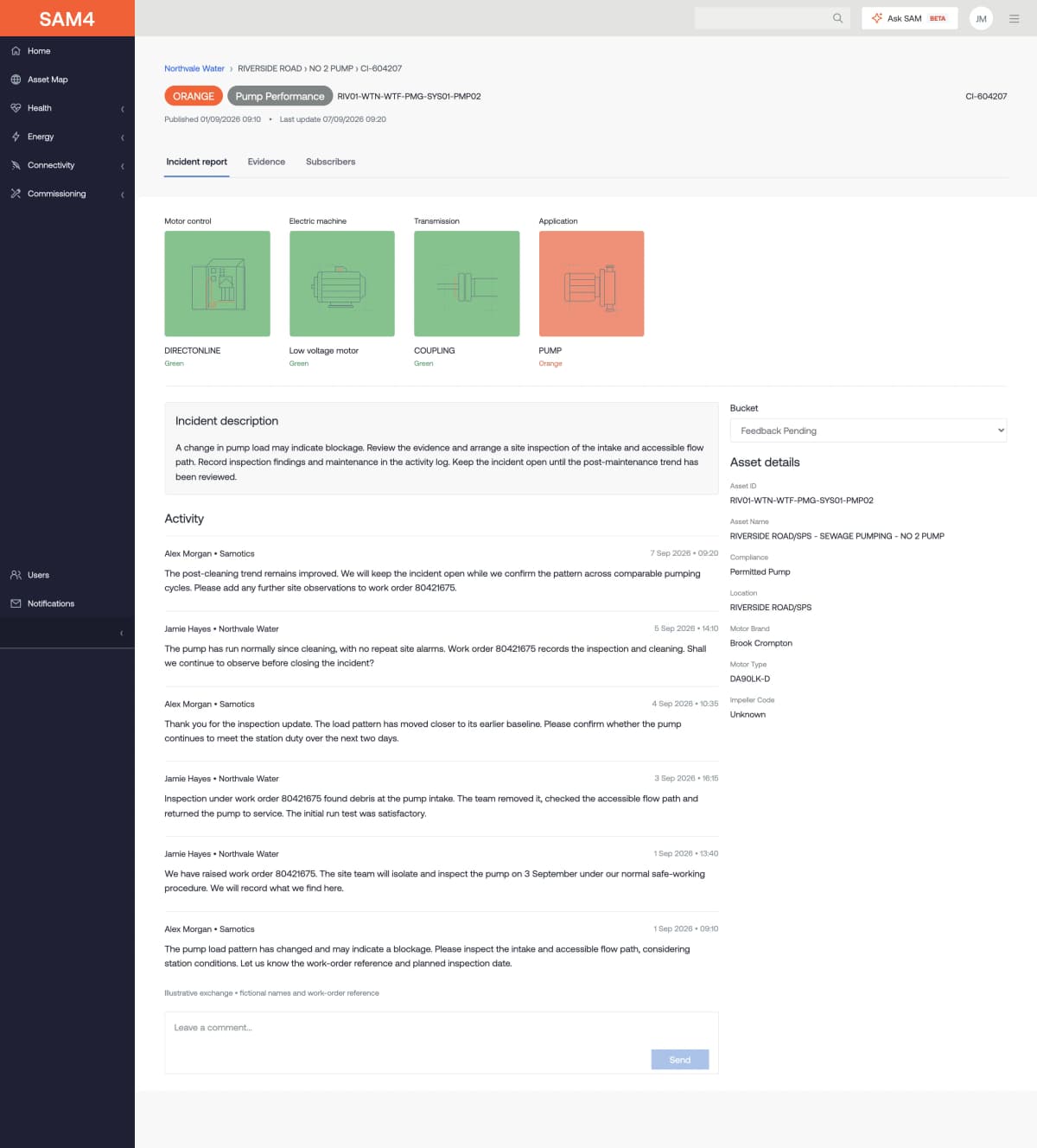
Keep the pump finding and response together. Review the reported pump-performance issue, recommended checks and the site team’s follow-up. The illustrated incident remains open pending observation.
Illustrative product view with fictional identifiers.
Signal flagged
Expert review
Fault classified
Assess the recommendation
What SAM4 detects on this asset, and where it doesn't fit
One table. Each fault class appears once with its signal path, the strength of field evidence on this asset class, and the recommended use of SAM4.
| Fault class | Signal path | Field evidence on this asset | Use SAM4 as |
|---|---|---|---|
| Clogging and ragging | Indirect / load. Debris shifts pump load before trip. | 1,213 scored events. 98.5% recall, 2.0% false-alert. See Yorkshire Water’s blockage response | Primary monitoring |
| Phase loss and voltage imbalance | Direct / electrical. Resolved at the cabinet. | 30+ scored events. No misses observed. | Primary monitoring |
| Sustained load-pattern anomalies | Indirect / load. Process-driven changes via motor current. | Detected consistently across the cohort. | Primary monitoring |
| Mechanical unbalance | Load signature + 1x running speed via the rotor. | Small sample. No misses observed. | Primary monitoring |
| Repeated abnormal duty cycles | Trend / infer across operating cycles. | Established on this asset class. | Primary monitoring |
| Air lock | Load step-change under variable duty. | Cases reviewed. Pattern detected consistently. See Southern Water’s airlock response | Primary monitoring |
| Impeller degradation or load shift | Long-window 1x harmonic trend. | Cases reviewed. Cohort still small. | Conditional |
| Cavitation-like patterns | Load signature + current variance. Severity not graded. | Useful as a flag, not a measurement. | Conditional |
| Bearing degradation | Indirect / late. Attenuated through the submerged assembly. | Vibration on accessible pumps remains better for raceway-level diagnosis. | Late-stage detection |
| Seal-related anomalies | Indirect / late. No reliable pre-leak signature. | SAM4 catches the root causes and cascaded effects, not the leak directly. | Late-stage detection |
Outside the envelope: structural defects and cavitation severity grading have no reliable electrical or load expression. Not claimed. Use hydraulic instrumentation where grading is required.
Where ESA fits in your monitoring architecture
On most submerged sewage pump fleets, SCADA covers process telemetry but no system monitors asset health inside the wet well. ESA fills that gap. It runs alongside what you already have, not in place of it.
Process layer
SCADA on flow, head, level, and kWh. Pollution sensors downstream. Process control on the VFDs. These tell you when the system stops performing. They don't tell you which pump is degrading, or why.
Asset-health layer
Continuous monitoring on every pump, read from the motor control cabinet. Each detection passes through expert review and arrives with an evidence tier showing the strength of the supporting field evidence. No wet well access. No extra sensors on the asset.
Specialised layer
Pre-leak seal moisture, very early-stage bearing pitting, water chemistry and process-quality monitoring. These sit outside what the electrical signature can resolve. Use seal-leak sensors for moisture. Use vibration spot-checks if your fleet warrants it.
ESA is not a replacement. It covers the continuous monitoring gap on submerged assets that vibration cannot reach at fleet scale, and reads the same signal that drives the pump.
Beyond the pump: watching the rising main.
One station pressurises each main. Monitor its pumps and the pressurised section is in view. No excavation, no sensors on the pipe.
A rising main (force main in the US) carries pressurised sewage for kilometres through ground nobody inspects. When it bursts, the station keeps pumping and sewage discharges until someone outside your organisation notices. Most stations have zero dedicated instruments on the buried main.
The pumps are the only powered assets wired into that pressurised section, so they feel a major burst within seconds. SAM4 reads the coordinated shift, power up, emptying time down, across every pump on the main, and confirms it as a system event through expert review before alerting. The signal scales with the discharge: the bigger the escape, the clearer the shift.
No sensors on the pipe. No excavation. The same cabinet install that watches pump health.
SAM4 detects
- Catastrophic escapes, and bursts large enough to threaten the environment, on the pressurised section.
- Events where pumps and pipe form one hydraulic system, confirmed as a system event through expert review.
SAM4 does not
- Detect slow seeps into the surrounding soil. Losses that small sit below the pumps detection floor.
- Pinpoint the burst location. The signal identifies the system, not the metre mark.
- Monitor gravity sections, once flow leaves the pressurised main.
Burst evidence is case-led: one public UK station, two detections. No recall figure is claimed for burst detection. See full rising main burst detection →
Pump performance curves from electrical data
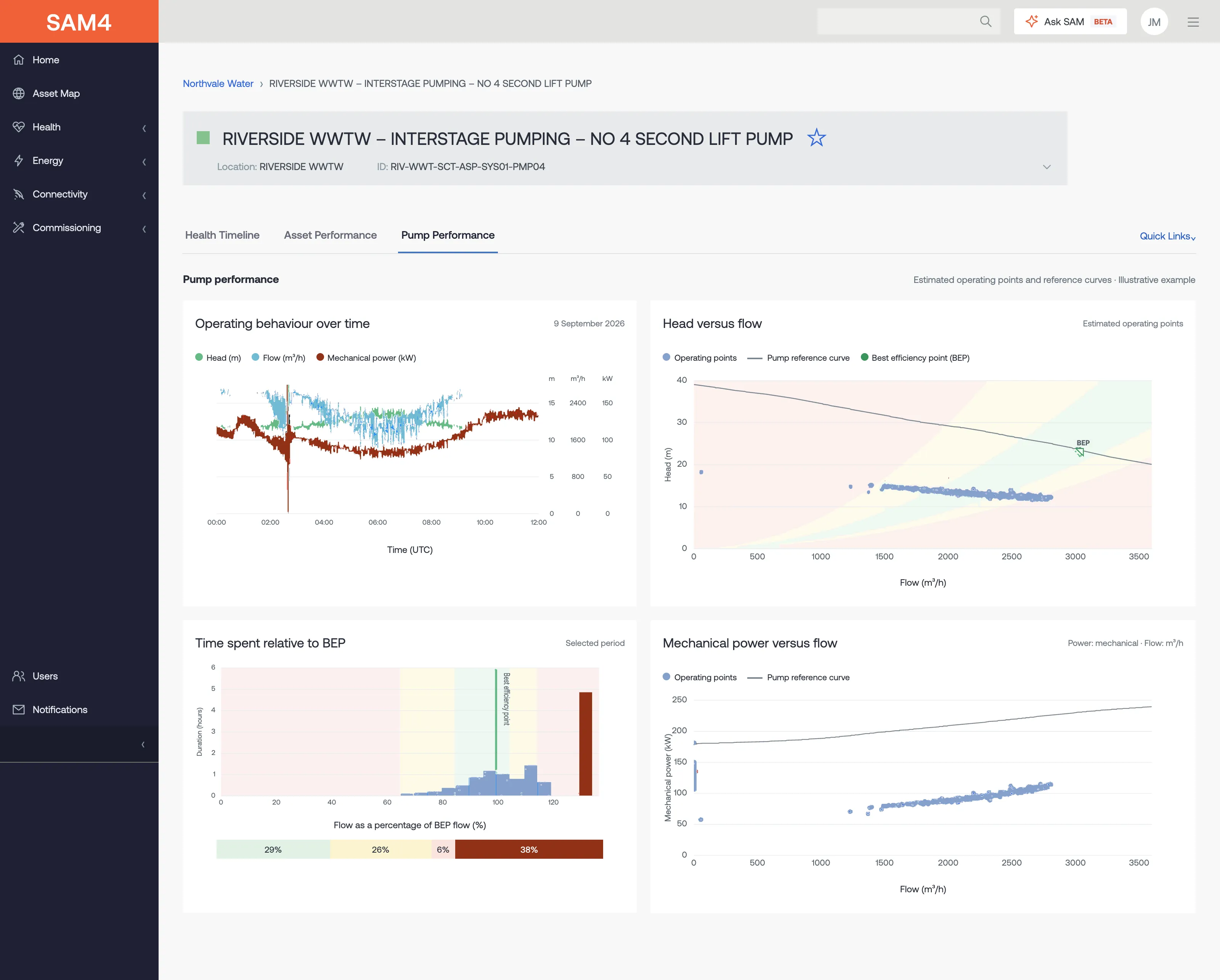
SAM4 calculates instantaneous head and flow using affinity laws and the pump's reference curve. The result is a real-time performance curve showing where each sewage pump operates relative to its best efficiency point. A pump drifting left of BEP signals cavitation risk. A curve shifting downward indicates impeller fouling, ragging, or wear ring degradation. The same view used to detect faults reveals where energy is being wasted.
Continuous BEP tracking
Every pump's operating point is tracked against its design curve. Deviation from BEP triggers alerts for cavitation risk, oversized duty, or fouling that shifts the curve. No manual test required, no flow meter needed.
Energy efficiency baseline
SAM4 benchmarks each pump's energy consumption against its theoretical optimum. The gap between actual and optimal consumption is your recoverable energy waste. Quantified per pump, per day. Especially relevant on stations where motors are sized for peak inflow but run far below design most of the time.
One sensor. Two value streams. The same electrical signal that detects faults reveals where pumps waste energy.
Explore Energy Optimisation →Real detections on submerged and submersible pumps
Blockage and airlock responses at Yorkshire Water and Southern Water, alongside energy performance and fleet deployment evidence.
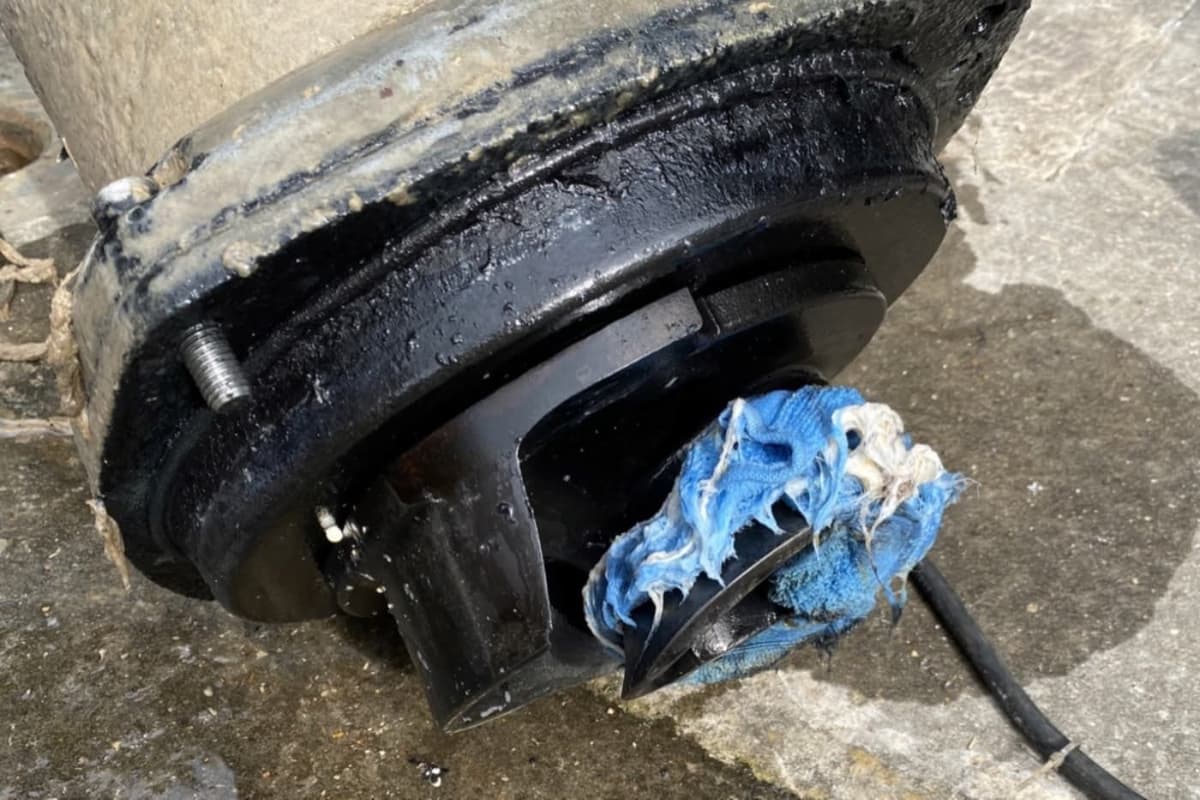
Yorkshire Water clears two blocked sewage pumps
When a second pump began to block, Yorkshire Water sent a team to clear both pumps. The client verified €190,000 in estimated avoided costs.
Southern Water responds to airlocks at Vicarage Road
An airlock alert led Southern Water to reset a tripped pump at Vicarage Road. Across three incidents, the client verified £738,000 in estimated avoided costs.
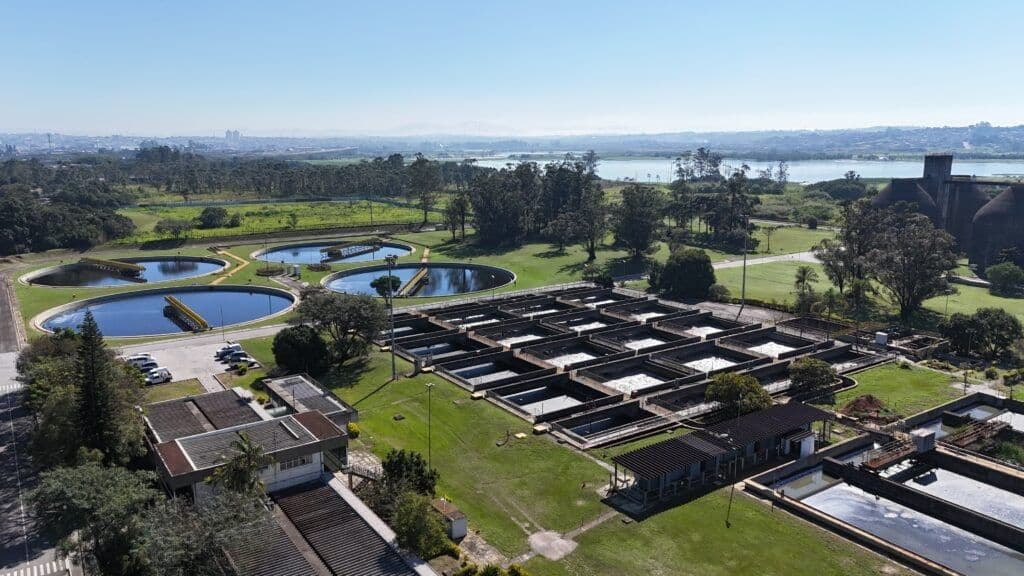
Improving submersible pump efficiency at Sabesp
SAM4 measured how far the submersible pumps had drifted from their design efficiency, showing the operator where energy was being lost.

“SAM4 delivers clear and actionable insights that enable our teams to make swift, informed decisions.”
Under 60 minutes. No wet well entry required
1. Open the motor control cabinet
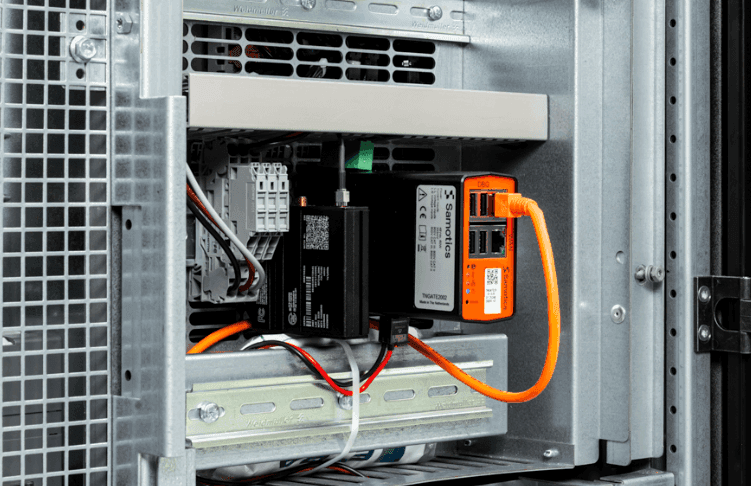
SAM4 installs at the MCC, the same panel your electricians already access. No wet well entry. No confined space permit. No interruption to the wet-well environment.
2. Clip sensors onto motor supply cables
Current and voltage sensors clip directly onto existing motor cabling. Installation requires a brief motor de-energisation while sensors are fitted, typically scheduled with operations. No wiring changes.
3. Connect and commission
The SAM4 gateway connects via cellular (4G/LTE). No dependency on your IT network. Monitoring starts immediately, with first diagnostic results within 48 hours.
Submerged sewage pump monitoring: common questions
Yes. SAM4 reads direct-on-line, soft-started, and variable-frequency-drive pumps. On DOL and soft-start, the supply current carries the fault signal directly. On VFDs, the drive output adds switching content to the waveform, so SAM4 reads on the drive output and accounts for the changing speed. Share the drive configuration during onboarding so the baseline is set correctly.
Intermittent duty works for the dominant fault modes. Clogging, ragging, and electrical faults show in every run, so a standby pump that cycles is still covered. The limit is on slower-building signatures: short, infrequent runs give less data, so trend-based detection such as early bearing wear takes longer to form a baseline. We state this honestly during the fit assessment.
Yes. Each pump is monitored independently from the same cabinet install. On pumps that share a rising main, this is an advantage: they become independent witnesses. A single-pump fault shows in one pump; a main burst shows a coordinated shift across all of them at once, which is how SAM4 separates a system event from a machine fault.
Vibration needs a sensor mounted on or near the asset. On a sealed pump 3 to 10 metres down a wet well, that is impractical at fleet scale and impossible on the worst-affected pumps. ESA reads the motor current at the cabinet, so no sensor enters the well. On accessible critical pumps, vibration remains the better tool for raceway-level bearing diagnosis. The question is coverage, not which technology wins. See how ESA compares.
SAM4 sends data over its own cellular connection, outside your IT and OT networks. There is no inbound connection to your systems. Samotics operates under ISO 27001 and ISO 9001, and the architecture is aligned with NIS2. See the security and network architecture.
All of them. A rising main in the UK is a force main in the US. A pumping station is a lift station. The submerged assets sit in a wet well. SAM4 monitors the pumps in lift stations and pumping stations, and watches the pressurised force main or rising main they feed, from the same cabinet install.
Methodology and validation detail
Reviewed evidence from the 12 months ending 2026-05-01. Exact counts and exclusions are in the validation report.
Review window
Window: 12 months ending 2026-05-01.
Every alert in the window is reviewed by a Samotics analyst and scored as: fault detected, fault missed, false communication, inconclusive, or not applicable. Inconclusive and not-applicable cases are excluded from both metrics.
Recall and false-alert share
Of all confirmed fault events in the review window, how many did SAM4 detect before the event was resolved or failed?
Recall on confirmed fault events = TP / (TP + FN)
False-alert share after review = FP / (TP + FP)

TP = confirmed fault events SAM4 flagged before resolution
FN = confirmed fault events SAM4 missed in the window
FP = reviewed alerts rejected as false after expert review
Related assets
Explore the wider context: Water & Wastewater industry and ESA Technology (ESA vs vibration).
Move sewage pump maintenance from reactive to scheduled.
Bring your asset list, drive configuration, and dominant failure modes. We will tell you what fits.