
Access gap
“
The conveyors at our hot strip mill are a critical part of the production process, but it’s virtually impossible to use manual or vibration-based techniques to assess their condition.
Monitoring coverage
Submerged pumps, enclosed drives and hazardous-area motors can be difficult to instrument. Periodic inspections leave gaps between checks. SAM4 uses electrical measurements at the motor control cabinet to monitor suitable assets without installing sensors on the machine.
Accessible critical assets get deep diagnostic coverage. Direct measurement, frequency-rich data, mature tools, trained analysts.
High-consequence assets where mounting and maintaining sensors is unsafe, expensive, intermittent, or impractical. Coverage is sparse precisely where consequence is high.
Easy access invites instrumentation. Useful, but not always where the next consequential outage is hiding.
Low-consequence assets where access is difficult and the risk-adjusted value of monitoring is low.
The problem is not that these assets are unimportant. The problem is that the monitoring model does not scale to them.
Vibration, ultrasound, thermography, visual inspection, and oil analysis all depend on getting close to the machine. That works for accessible assets. It breaks down when assets are submerged, sealed, hazardous, remote, or distributed across hundreds of motors. These are not edge cases. They are the structural blind spot left by proximity-based monitoring. For years, the result was mainly a reliability problem: faults developed where teams had little or no continuous condition data.
Maintenance workflows, energy programmes, operational dashboards, digital twins, and AI optimisation systems all need trusted asset-level evidence. But many motor-driven assets still do not produce continuous data on condition, load, runtime, energy use, or operating behaviour. The CMMS knows the work orders. SCADA knows the process. Energy systems know meter-level consumption. Digital twins know the model. What is often missing is the asset's own operating evidence. Without it, twins run on assumptions. Energy programmes rely on estimates. Predictive maintenance defaults to schedules. AI models learn from inferred state, not observed state. SAM4 closes that gap from the motor control cabinet: current and voltage become a continuous asset data layer for motor-driven equipment.
Proximity-based monitoring has worked for decades on assets teams could reach. The assets outside that model are becoming harder to ignore. Three pressures are pushing the old model past its limits: people, risk, and data.
Industrial diagnostic judgement still depends heavily on experienced engineers. Many are retiring faster than organisations can replace them.
That judgement has to move into systems: validated field data, repeatable diagnostics, and clear recommendations that help less experienced teams act with confidence.
Under-monitored assets now carry more consequence. Downtime, safety risk, pollution events, energy waste, carbon reporting, and insurance pressure make periodic snapshots and reactive maintenance harder to defend.
Motor-driven systems are also a large part of industrial electricity use. Without asset-level data on load, runtime, energy use, and abnormal operation, teams struggle to identify which assets create waste and which interventions are worth prioritising.
CMMS automation, digital twins, energy platforms, carbon reporting, and AI optimisation systems all need trusted asset-level evidence.
Models and estimates help, but they cannot replace continuous operating data from real assets: condition, load, runtime, energy use, and abnormal behaviour. Without that data, digital systems become better interfaces for incomplete assumptions.
The motor control cabinet already carries the electrical signal that powers the asset. SAM4 turns that signal into continuous asset evidence. Some issues appear directly in current and voltage. Others appear because faults or process changes alter torque, speed, load, or electromagnetic balance. That gives SAM4 a way to monitor hard-to-reach motor-driven assets without mounting sensors on the machine. It also closes the deeper data gap: condition, load, runtime, energy use, and operating behaviour can become available to the systems that need them.
High-resolution current and voltage captured at the motor control cabinet.
Physics-first ESA. Physics-based signatures and asset-specific baselines separate developing faults from normal operating variation.
Reliability engineers review ambiguous, urgent, and edge-case findings before notification.
Validated findings and asset-level metrics route into CMMS, dashboards, APIs, reports, or team notifications.
See how ESA works →·Explore what SAM4 monitors →·View the installation model →
Current and voltage data can help teams assess equipment condition, operating behaviour and energy use. Fault findings support maintenance investigations. Performance and energy estimates need to be assessed alongside operating conditions before your team changes the process.
Condition findings are the most directly actionable. SAM4 detects developing fault patterns, validates customer-facing findings, and sends maintenance teams the likely fault type, severity, supporting evidence, and recommended next action.
Best for: inspections, planned maintenance, fault escalation, CMMS work orders.
Performance insights show how assets run: runtime, starts, stops, load, speed, duty cycle, abnormal operating patterns, and supported pump-performance estimates.
The data shows the operating pattern. Your team applies process context to decide whether to change sequencing, control logic, duty allocation, or maintenance planning.
Best for: operational review, control improvements, duty-cycle analysis, digital twins, and asset-performance models.
Energy insights show consumption, load, losses, operating efficiency, and saving potential. SAM4 can rank opportunities and show where waste is likely occurring.
It does not replace process engineering. Setpoint changes, control strategy, motor rightsizing, retrofit choices, and capital decisions remain customer decisions.
Best for: energy reviews, ISO 50001 programmes, sustainability reporting, asset replacement planning, and energy-saving project prioritisation.
Together, these outputs turn hard-to-reach motors into an asset-level data source: condition actions for maintenance, operating evidence for reliability and operations, and energy decision support for engineering and sustainability teams.
SAM4 is not a process optimiser, SCADA replacement, vibration replacement, or generic dashboard layer. It produces trusted asset-level evidence: validated fault findings, condition trends, energy use, runtime, load, operating behaviour, and performance indicators. Your CMMS, data platform, digital twin, energy programme, process team, or reliability team uses that evidence to decide what happens next. ESA and vibration are complementary. Vibration remains strong for accessible, high-criticality machines where sensors can sit close to the fault path. ESA adds coverage where access, signal transmission, or deployment economics make vibration hard to scale: submerged assets, ATEX-zone motors, enclosed machines, remote stations, distributed motor fleets, electrical issues, and process or load-path changes. The principle: SAM4 sends better asset data into the systems and teams that already make industrial decisions. It does not replace those systems or teams.
Electrical Signature Analysis has existed for decades. But fleet-scale ESA is not a formula library. It requires a full production stack: reliable measurement, fleet operations, physical interpretation, asset context, field validation, and workflow delivery.
Production ESA improves when real outcomes close the loop. New asset types extend the signature library. Confirmed faults refine models. False alerts tighten validation. Missed findings expose blind spots. Resolved work orders connect signal evidence to physical reality.
The advantage is not only the algorithm. It is the combination of measurement infrastructure, physics, asset context, field-labelled outcomes, and operational feedback.
Three customers. Three views of the same problem: assets that are critical, hard to monitor, and easier to manage once the signal becomes visible.
The conveyors at our hot strip mill are a critical part of the production process, but it’s virtually impossible to use manual or vibration-based techniques to assess their condition.
We invested heavily in condition-based maintenance — vibration, oil analysis, airflow, the lot. But those approaches can still be snapshots. SAM4 added continuous visibility.
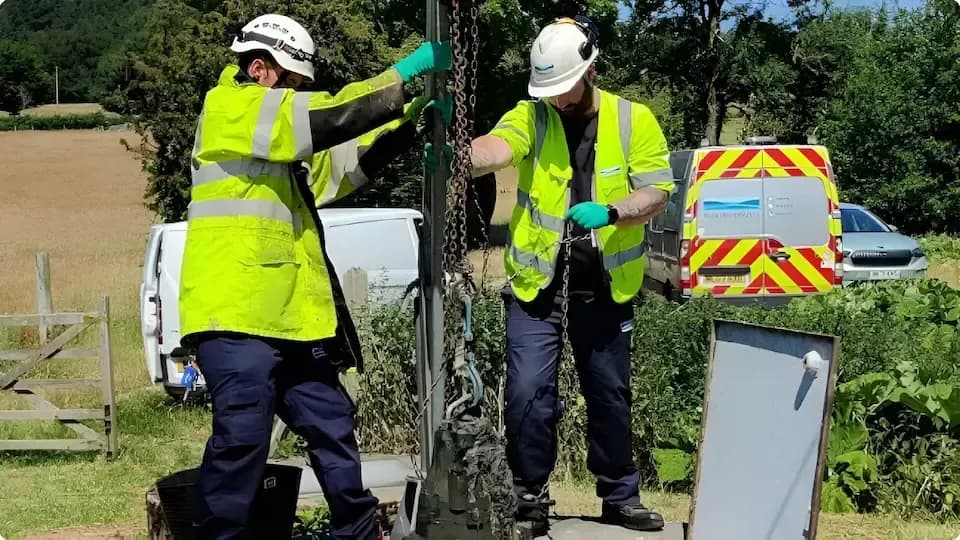
SAM4 brought to my attention issues with one of our submersible pumps located in a busy office carpark. This insight helped me to plan crews, issue notifications and permits, as well as organize a 25-ton crane.
SAM4 performance is measured on resolved customer-facing incidents from live industrial deployments. Performance varies by asset type, operating regime, fault mechanism, and signal path. That is why headline metrics should be read with the methodology, not as universal guarantees for every asset and every failure mode.
Recall = fault detected / (fault detected + fault missed). False-alert rate = false communication / (fault detected + false communication).
Reporting window: 1 May 2025 to 1 May 2026. Source: 2,087 customer incidents from live industrial deployments. Inconclusive, not applicable, and unresolved outcomes are excluded from the metric denominators.
Metrics are reviewed quarterly. Performance is published by asset type and failure mode where the evidence base supports it.
In 30 minutes, we review your asset types, access constraints, failure history, and maintenance priorities to identify where cabinet-based monitoring is likely to fit. Engineer-to-engineer. No SDR layer.