
Centrifugal pump monitoring
Centrifugal pumps operate under changing loads, batch cycles and recirculation conditions. SAM4 detection performance varies by fault mode. The sections below set out the evidence and the conditions affecting bearing and mechanical-seal detection.
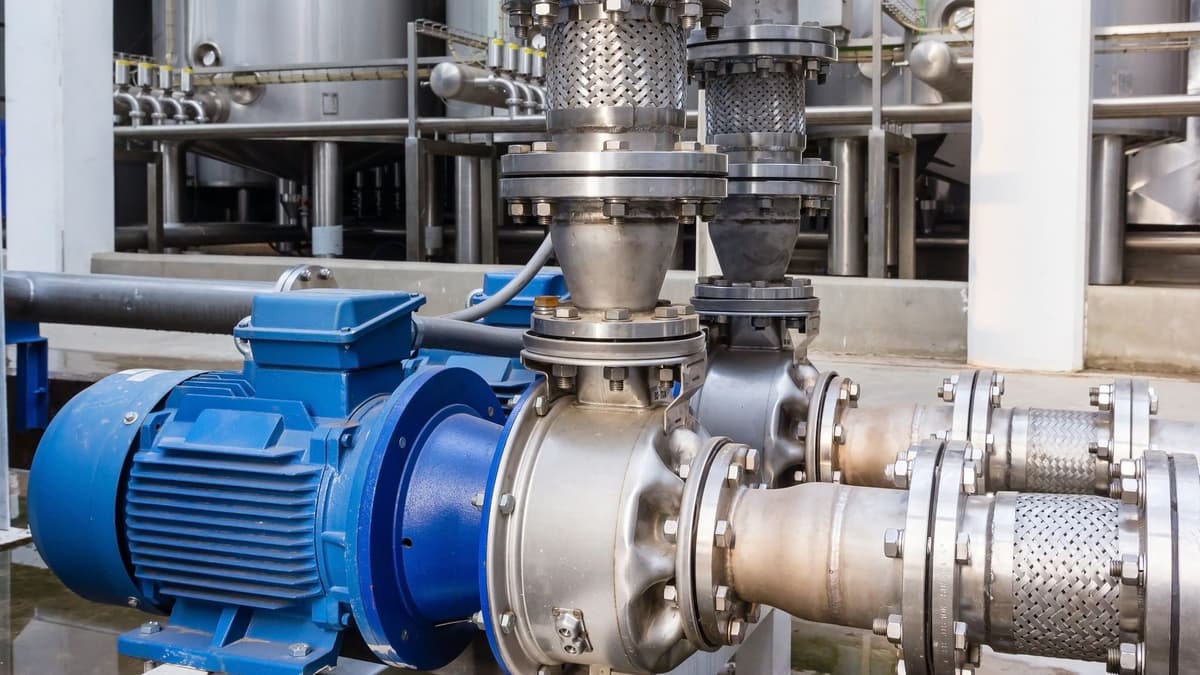
Centrifugal pumps live everywhere. Vibration cannot reach all of them.
Mounted vibration analysis is the diagnostic gold standard on accessible pumps. ESA does not replace it. ESA covers the pumps vibration cannot reach, sealed, ATEX, hard-access, hot-side, remote, and provides continuous fleet-scale coverage on the rest. This page is honest about the trade-offs that come with that reach.
The reach
Where vibration sensors cannot be safely or affordably mounted, ESA reads the pump from the cabinet. One installation point covers the motor, drivetrain, impeller, and process load.
The precision
Post-review false-alert rate is 2.1% across the SAM4 fleet, calculated across 1,402 customer-facing detected and false-alert outcomes. Reliability engineers who action SAM4 alerts find a real fault on the large majority of cases. Engineering hours are not wasted on chasing ghosts.
Detection limits
Centrifugal process pumps are the most variable asset class. Performance varies materially by fault mode. We publish per-fault evidence, the cohort, and the boundary, rather than a pooled headline.
“SAM4 felt different from other condition monitoring tools. It was simple. And it worked.”
How ESA reads centrifugal pumps
SAM4 reads three-phase current and voltage at the motor control cabinet. Faults that modulate motor torque or alter winding impedance reach this signal. The pump is sealed; the motor is not, electrically. This is the same physics that makes ESA useful on any other induction-motor-driven asset, applied to the largest, most variable asset class in the plant.
Mechanical and electrical faults modulate the air-gap magnetic field, which modulates the stator current. SAM4 analyses the frequency spectrum of this current and resolves rotor-bar sidebands, eccentricity harmonics, bearing defect frequencies, supply-side anomalies, and load-pattern shifts. On centrifugal pumps, the load path matters as much as the motor path: blockage, cavitation, dry running, air lock, and impeller wear all reach the motor as torque-ripple or current-mean changes through the rotor.
Strongest pathways: direct electrical (unbalance, supply quality), motor-side electromagnetic (rotor bars, eccentricity), and load-signature (blockage, process anomalies, mechanical unbalance, coupling, belt drives). Conditional pathways: mechanical-seal leakage where there is no torque modulation, and bearing-side detection on intermittent or batch duty where vibration on accessible pumps remains the better tool.
Our sensorless pump monitoring guide explains the hardware involved, performance estimates, and practical use cases.
Direct electrical
Phase imbalance, voltage sags and swells, harmonic distortion, and stator winding faults are visible at the supply side. Captured at the cabinet directly. No drivetrain modelling needed.
Motor-side electromagnetic
Broken rotor bars, end-ring faults, and air-gap eccentricity produce sideband signatures in the current spectrum. The physics is shared with every other induction motor SAM4 monitors.
Load signature
Blockage, cavitation, dry running, air lock, mechanical unbalance, coupling and belt drive faults, and process anomalies reach the motor as torque-ripple or sustained current shifts. Strongest pump-side signal class.
What ESA does not see
Mechanical-seal leakage that does not change motor load. Casing cracks. Pipework integrity. Bearing-side raceway detail on intermittent duty. Pair with vibration on accessible critical pumps.
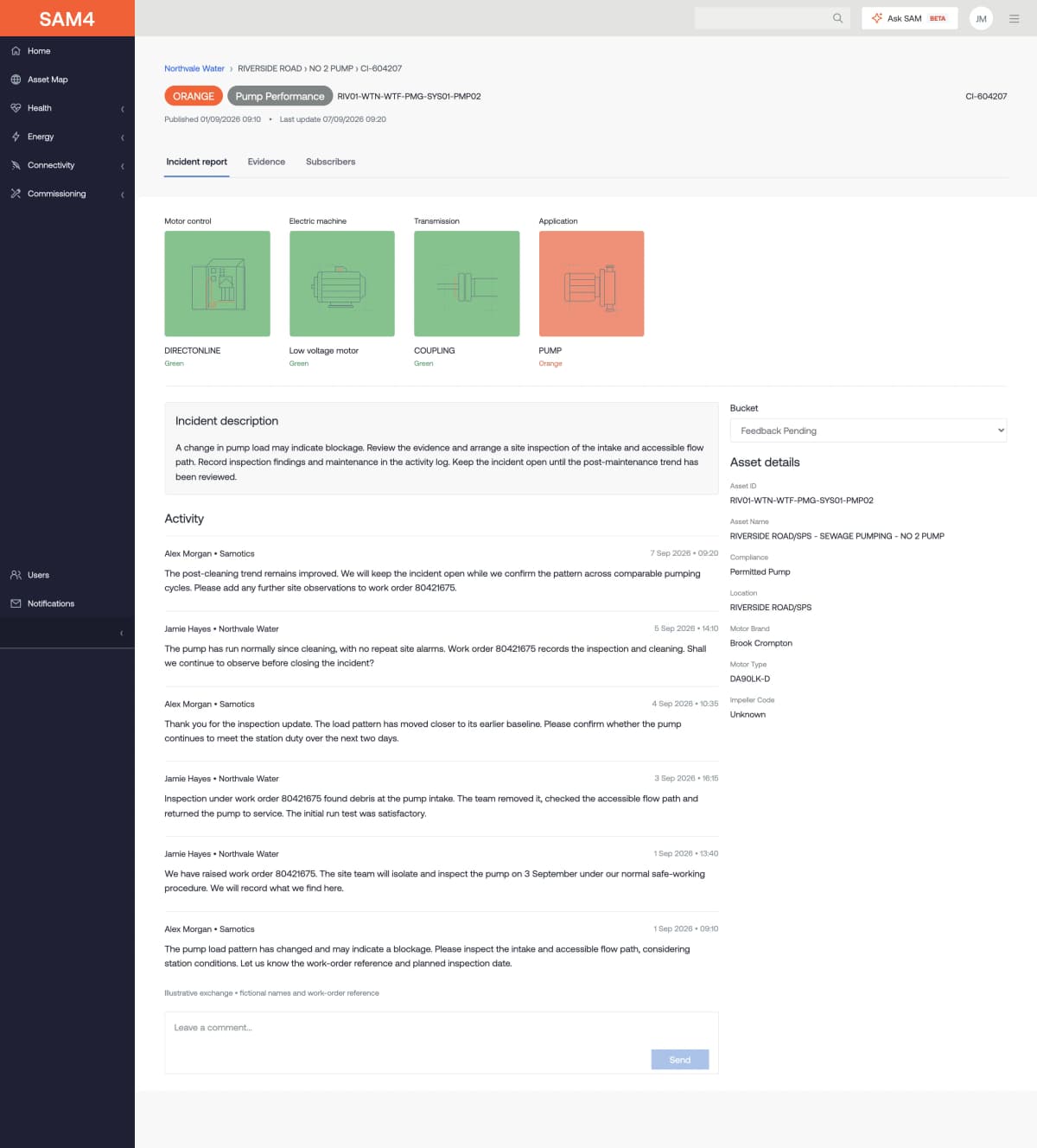
From a pump finding to a site response. Read the reported finding, recommended checks and maintenance feedback together. The illustrated incident remains open while the team observes the asset.
Illustrative product view with fictional identifiers.
Signal flagged
Expert review
Fault classified
Action recommended
Pump performance curves from electrical data
SAM4 calculates instantaneous head and flow using affinity laws and the pump's reference curve. The result is a real-time performance curve showing where each pump operates relative to its best efficiency point. A pump drifting left of BEP signals cavitation risk. A curve shifting downward indicates impeller wear or wear ring degradation.
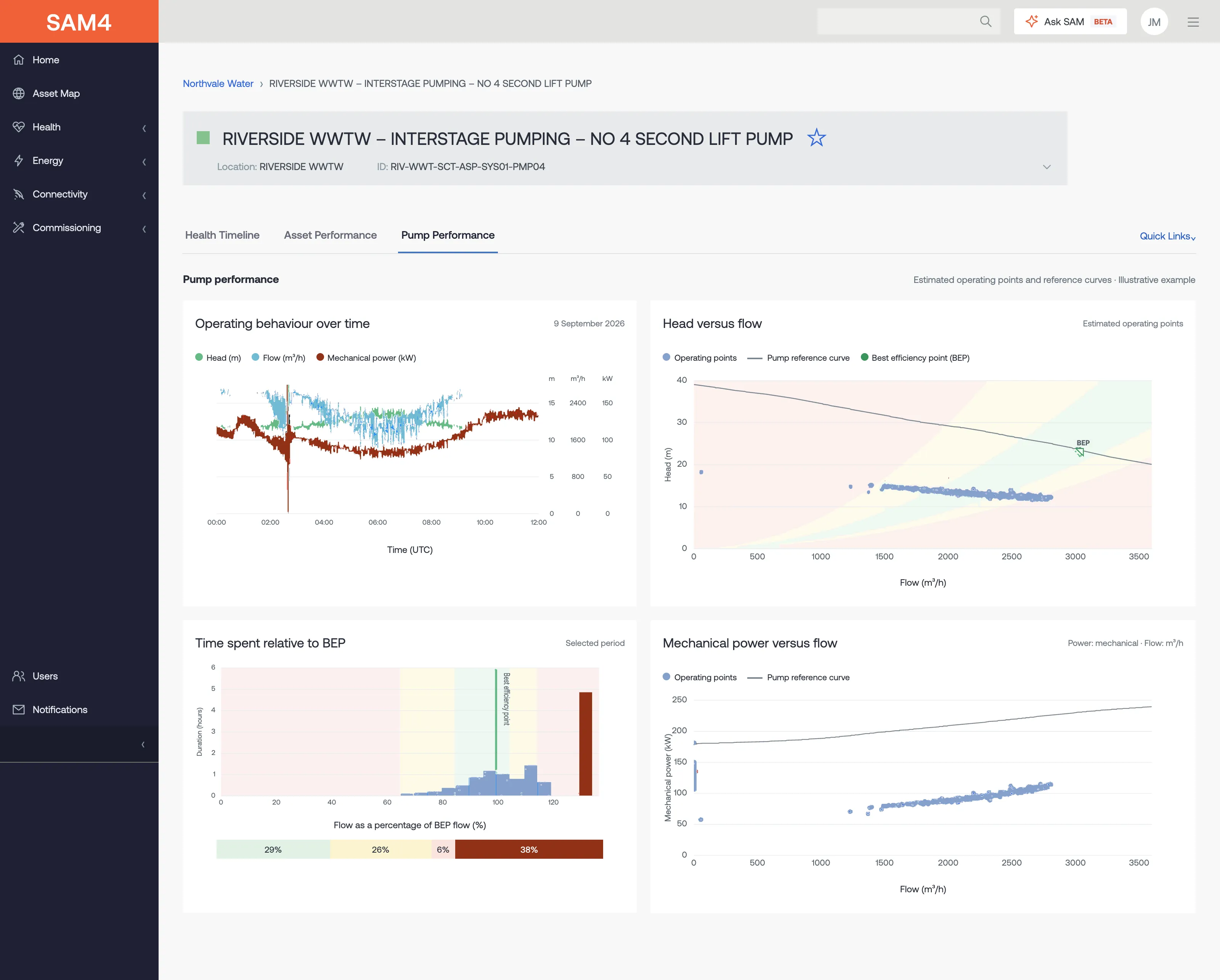
Continuous BEP tracking
Every pump's operating point is tracked against its design curve. Deviation from BEP triggers alerts for cavitation risk, oversizing, or system resistance changes. No manual test required.
Energy efficiency baseline
SAM4 benchmarks each pump's energy consumption against its theoretical optimum. The gap between actual and optimal consumption is your recoverable energy waste. Quantified per pump, per day.
Vitens: 7.1% energy efficiency gain
Dutch water utility Vitens used SAM4 pump curve data to identify pumps operating far from BEP. Hydraulic rerating of a single booster station cut energy use by 7.1%, equivalent to 9.9 tonnes of CO₂ per year.
One sensor. Two value streams. The same electrical signal that detects faults reveals where pumps waste energy.
Explore Energy Optimisation →What SAM4 detects on pumps, by pathway
ESA performance on pumps depends on the pathway. Strongest where the cabinet sees it directly. Confirmed where physics is mature. Indirect or limited where signal physics is harder. The table is the same canonical structure used across asset pages: each fault appears once, with its pathway, its maturity, and the evidence note.
The reviewed sample behind this page is 100+ scored centrifugal process pump cases in the current 12-month review window. Ragging on submerged sewage pumps is the largest pump sample overall, and is published on the submerged sewage pumps page. The table below covers the strongest pathways for non-sewage centrifugal pumps. Where the sample is below 50, we show counts and label maturity rather than publishing a percentage.
| Fault | Pathway | Maturity | Evidence note |
|---|---|---|---|
| Voltage imbalance | Direct electrical | Proven | Above 95% recall on the centrifugal cohort. Captured at the cabinet directly. Strongest pathway on this page. |
| Mechanical unbalance | Load signature + 1x running speed | Proven | Above 95% recall on the centrifugal cohort. Across-cohort consistency on rotor and pump-side imbalance. |
| Process-induced load deviation | Load signature | Proven | Pooled across the pump cohort, recall sits in the field-proven band. Sustained load shifts and operating-point drift reach the current as torque change. |
| Belt degradation | Transmission path + belt-pass frequency | Proven | Strongest pathway on belt-driven pumps. Cross-asset proof on belt drives. |
| Coupling-related load anomaly | Load signature + 1x | Developing | Small reviewed sample on this page. No misses observed. Counts available in the validation report. |
| Cavitation | Load signature + current variance | Developing | Small reviewed sample on the centrifugal cohort. Pathway resolved on cross-asset cohorts. |
| Air lock | Load step-change | Developing | Small reviewed sample. Counts only on this page; pathway is the same as dry-running. |
| Shaft or coupling misalignment | Load signature + 2x | Developing | Small reviewed sample. Pathway resolved on cross-asset cohorts; vibration phase analysis discriminates root cause. |
| Impeller degradation | Long-window 1x harmonic trend | Developing | Detected indirectly through load-signature drift. Small reviewed sample. |
| Dry running | Load step-change | Developing | Detected indirectly through current dropout. Small reviewed sample. |
| Bearing degradation indicators | Indirect electromagnetic + load | Developing | Stable runtime helps; intermittent duty thins the signal. Vibration on accessible critical pumps remains the better tool for raceway-level diagnosis. |
| Stator winding short indicators | Direct electrical | Developing | Small reviewed sample on the centrifugal cohort. Pathway resolved on cross-asset cohorts. |
| Rotor bar degradation | Indirect electromagnetic | Developing | Pathway resolved on cross-asset cohorts. Centrifugal-specific cohort still building. |
| Seal-related load anomaly | Outside ESA envelope (direct) | Early-stage | Seal anomalies produce no torque modulation, so ESA cannot see the leak directly. SAM4 catches the root causes (misalignment, unbalance, cavitation) and cascaded effects. |
Detection boundaries on pumps
ESA reads motor current. Faults that do not modulate torque do not reach the signal. Some show up only as secondary effects. We are explicit about which.
- Bearing degradation indicators (motor-side). Motor bearings produce subtler ESA signatures than pump-side mechanical events. On stable-load duty the signal is detectable; on intermittent duty it thins. Vibration on accessible critical pumps remains the better tool for raceway-level diagnosis.
- Seal-related anomalies. Aggressive media (acids, hydrocarbons, hot oils, abrasives) attack seals more than wet-well water does. Seal weep produces no torque modulation. ESA detects root causes and cascaded effects, not the leak itself.
- Casing integrity, piping, and external mechanical condition. Outside ESA's reach. Pair with periodic inspection.
- Casing integrity, piping, and external mechanical condition. Outside ESA's reach. Pair with periodic inspection. One exception at system level: a major burst on a pressurised rising main shifts the hydraulic load on every pump on the main at once, and SAM4 flags that coordinated shift. See rising main burst detection →
No condition monitoring technology detects everything. These are the known limitations. We publish them so engineers can make better decisions. Exact counts, fault mix, misses, and false alerts are available in the validation report on request. See validation context.
What SAM4 detects on this asset, and where it doesn't fit
One table. Each fault class appears once with its signal path, the strength of field evidence on this asset class, and the recommended use of SAM4. The signal path is defined by physics. The recommendation reflects what we suggest you act on.
| Fault class | Signal path | Field evidence on this asset | Use SAM4 as |
|---|---|---|---|
| Phase loss and voltage imbalance | Direct / electrical. Resolved at the cabinet from current and voltage symmetry. | Above 95% recall on the centrifugal cohort. | Primary monitoring |
| Mechanical unbalance | Load signature + 1x running speed. Reaches motor current through the rotor. | Above 95% recall on the centrifugal cohort. Consistent across rotor and pump-side imbalance. | Primary monitoring |
| Process-induced load deviation | Load signature. Sustained load shifts and operating-point drift reach the current as torque change. | Detected consistently across the pump cohort. | Primary monitoring |
| Belt degradation | Transmission path + belt-pass frequency. Sub-synchronous belt-pass passes cleanly through motor inertia. | Strong detection pathway on belt-driven pumps. Cross-asset proof established. | Primary monitoring |
| Coupling-related load anomaly | Load signature + 1x. | Small sample reviewed. No misses observed. | Conditional |
| Shaft or coupling misalignment | Load signature + 2x. | Small sample reviewed. Vibration phase analysis discriminates root cause. | Conditional |
| Cavitation-like operating patterns | Load signature + current variance. Pattern visible. Severity not graded. | Cases reviewed on the centrifugal cohort. Useful as a flag, not a severity measurement. | Conditional |
| Air lock | Load step-change. Operating point change under variable duty. | Cases reviewed. Pattern detected consistently. | Conditional |
| Impeller degradation or load shift | Long-window 1x harmonic trend. Detectable where the load actually shifts. | Cases reviewed. Cohort still small. | Conditional |
| Dry running | Load step-change. Detected through current dropout. | Small sample reviewed. | Conditional |
| Stator winding short indicators | Direct electrical. | Small sample reviewed on the centrifugal cohort. Pathway established across asset classes. | Conditional |
| Rotor bar degradation | Indirect electromagnetic. | Pathway established across asset classes. Centrifugal pump cohort still building. | Conditional |
| Bearing degradation | Indirect electromagnetic + load. Visible once degradation reaches the motor current. | Stable runtime helps; intermittent duty thins the signal. Vibration on accessible critical pumps remains the better tool for raceway-level diagnosis. | Late-stage detection |
| Seal-related anomalies | Outside ESA envelope (direct). No torque modulation. | Seal anomalies produce no torque modulation, so ESA cannot see the leak directly. SAM4 catches the root causes (misalignment, unbalance, cavitation) and cascaded effects. | Late-stage detection |
| Structural defects | Outside envelope. No reliable electrical or load expression. | Not claimed. | Use other methods |
| Cavitation severity grading | Outside envelope. Pattern visible. Severity calibration is out of scope. | Use hydraulic instrumentation if grading is required. | Use other methods |
Choosing ESA and vibration for your pumps
On centrifugal process pumps, ESA and vibration are most powerful when they run together. ESA gives fleet-scale coverage and reaches where vibration cannot. Vibration gives high-frequency local detail on accessible critical pumps. The smart deployment is both, scoped by access and consequence.
ESA is strongest when
- Pump is sealed, hot, in ATEX, or hard-access
- One cabinet location must monitor a fleet of pumps
- Coupling, alignment, or off-design operation are the dominant risks
- Continuous coverage across stable-duty assets is the priority
- The same signal must carry condition + performance + energy
Both can help when
- Pump is critical enough to warrant defence in depth
- Bearing localisation needs both load-pattern and high-frequency vibration data
- Trend confirmation across two methods reduces false-alert risk further
- Root-cause investigation needs multiple viewpoints on the same asset
Vibration is strongest when
- Accessible pump where the sensor can be safely mounted and maintained
- Specific bearing or raceway-level diagnostics are needed
- High-frequency local vibration analysis is required
- Foundation, structural, or piping resonance is the suspected fault
Real faults caught on centrifugal pumps
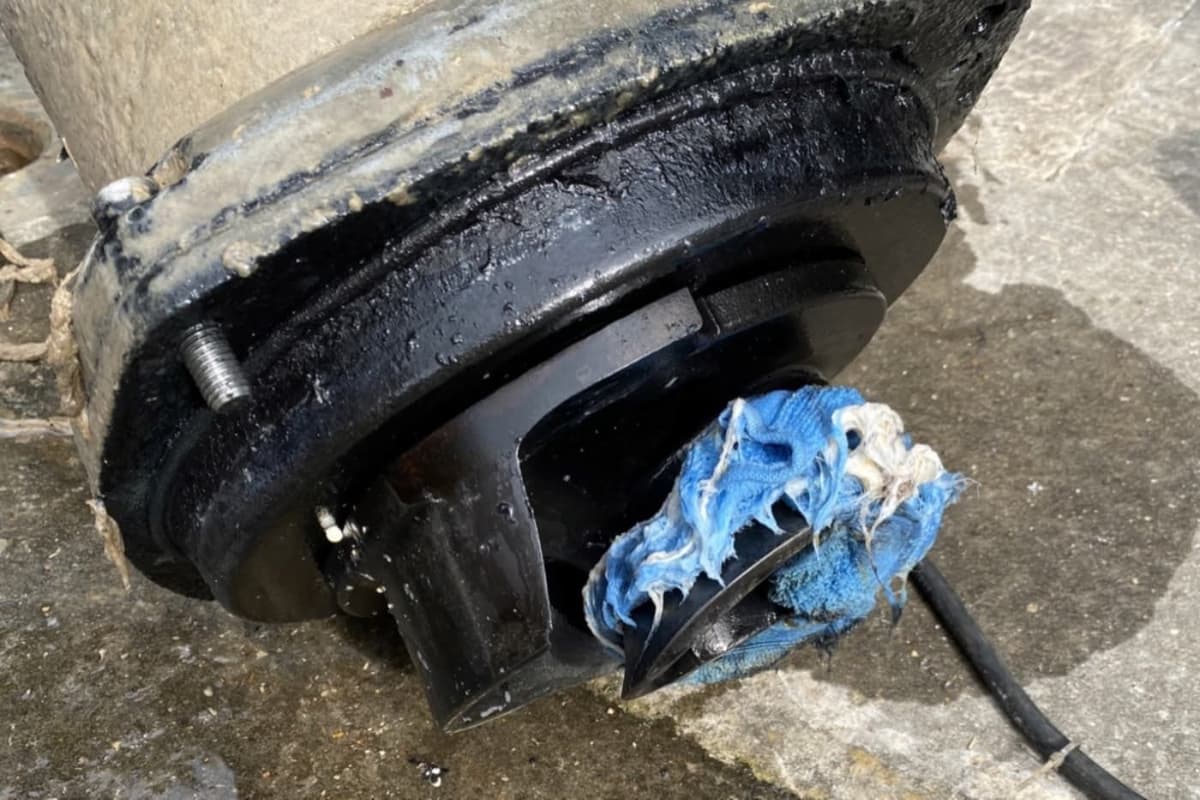
Yorkshire Water clears two blocked sewage pumps
When a second pump began to block, Yorkshire Water sent a team to clear both pumps. The client verified €190,000 in estimated avoided costs.
Southern Water responds to airlocks at Vicarage Road
An airlock alert led Southern Water to reset a tripped pump at Vicarage Road. Across three incidents, the client verified £738,000 in estimated avoided costs.

How Vitens increased operational efficiency by 7% through real-time asset measurements
Three booster pumps at the largest water utility in the Netherlands had lost 10% efficiency. Real-time measurement showed exactly where it had gone.
Show more (19)Show fewer
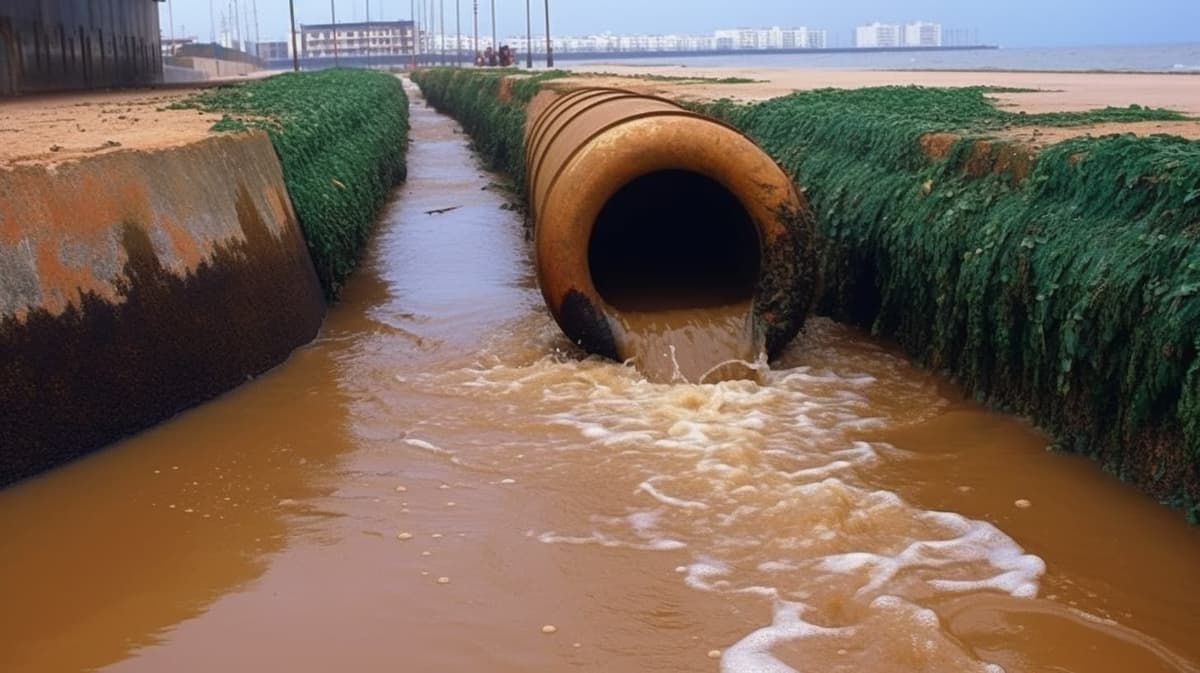
Alert prevents pollution incident and saves €100k
The customer's own vibration system saw nothing. SAM4 picked up the developing fault on the sewage pump and the repair was made before it failed.
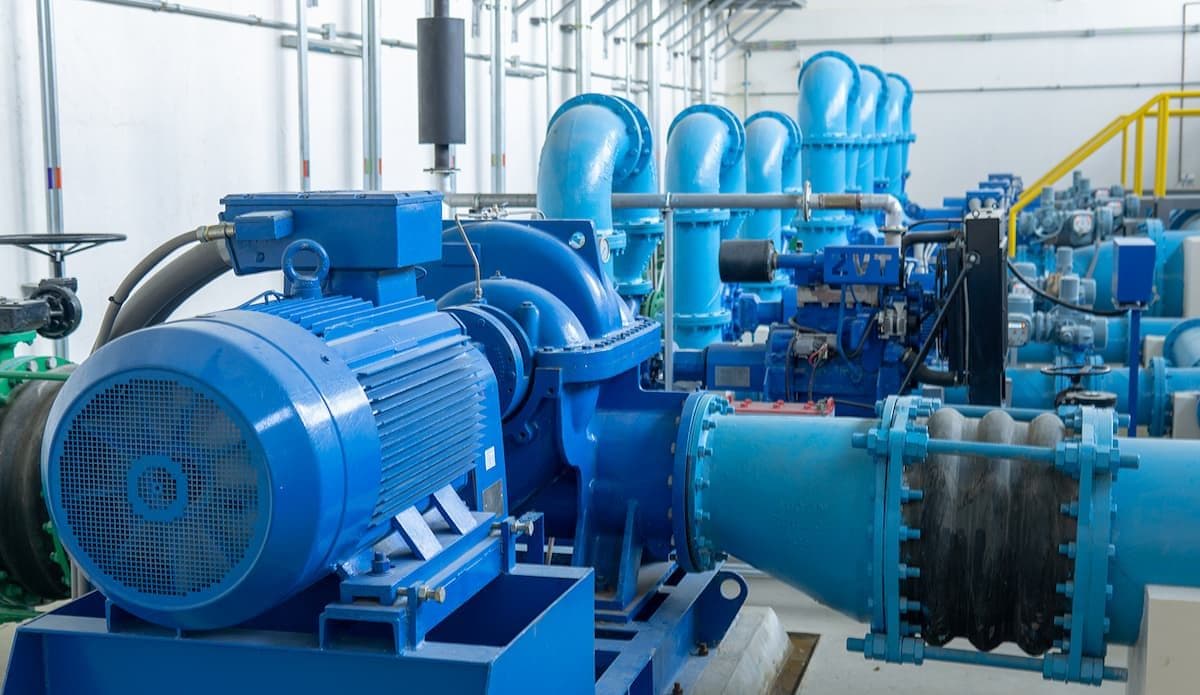
Hydraulically rerating an existing booster pump station to reduce energy cost by €99k a year
Two identical booster pumps ran the same duty. Rerating one to match actual demand cut energy cost while keeping full backup capacity.

Condition monitoring for anolyte pumps: a case study
Read how SAM4 saved this chemical manufacturer 15 thousand euros by detecting cavitation-induced pump damage.

Condition monitoring for centrifugal pumps: a case study
A tank storage operator was running a centrifugal pump off its best efficiency point. SAM4 flagged it before the wear became chronic.

Condition monitoring for circulator pumps: a case study
Read how SAM4 caught misalignment between this pump's gearbox and motor 7 months in advance for a chemical customer.

Condition monitoring for cooling pumps: a case study
Read how SAM4 caught a missing foundation bolt in a cooling pump for this food & beverage manufacturer.

Condition monitoring for oil transfer pumps: a case study
Read how SAM4 spotted coupling, vane and foundation issues in time to avoid pump failure for this tank storage customer.
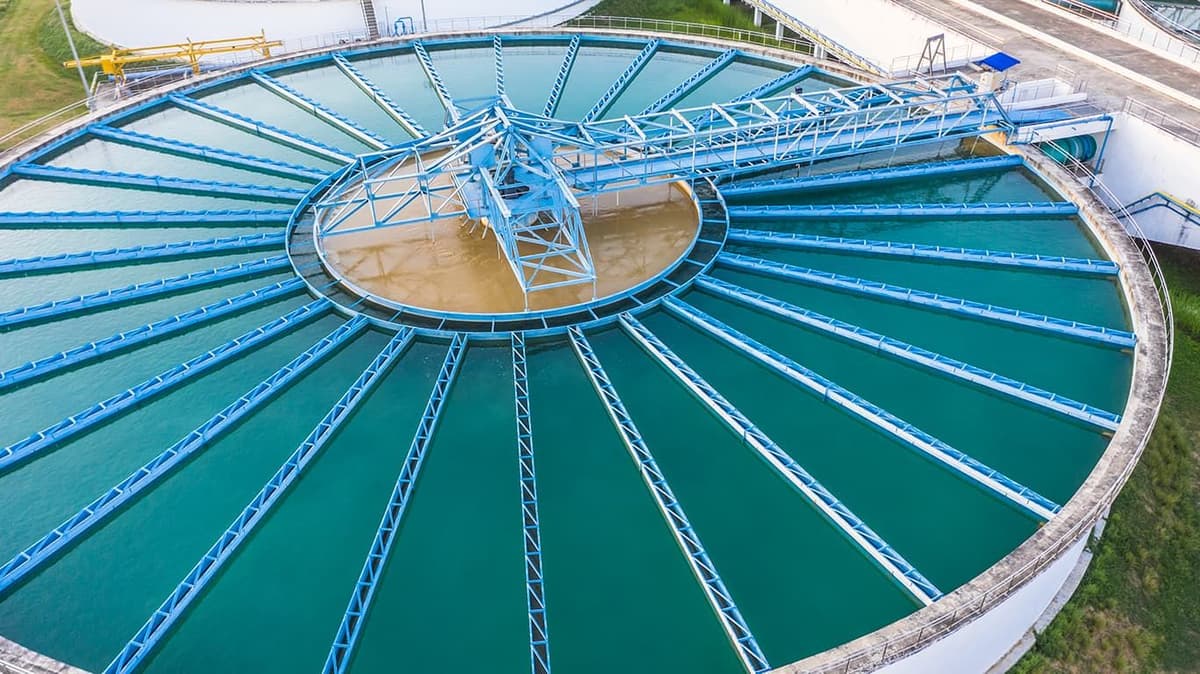
Condition monitoring for wastewater pumps: a case study
Read how SAM4 alerted this water industry customer to debris that had started to block this wastewater collection pump's intake.

How zinc smelter Nyrstar got 800% ROI in 11 months
Continuous monitoring on the smelter's critical drivetrains caught faults early, including a 10 kV rectifier cable fault that would have caused over €1 million in equipment damage.

Identifying and fixing a broken sine wave filter in electric submersible pumps
Recurring ESP problems had no obvious cause. Irregular harmonic and voltage patterns at the surface VFD traced them to a failed sine wave filter.
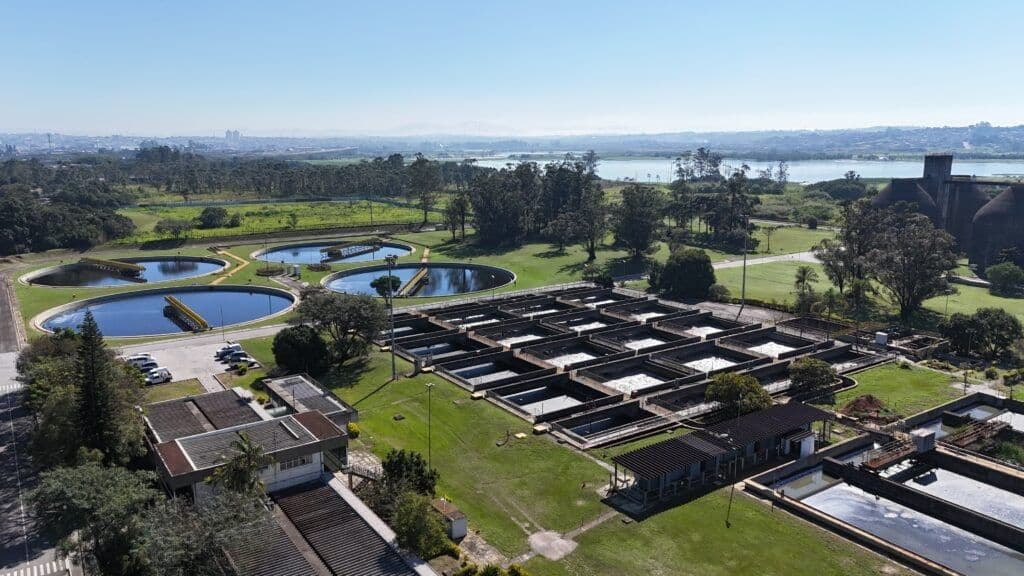
Improving submersible pump efficiency at Sabesp
SAM4 measured how far the submersible pumps had drifted from their design efficiency, showing the operator where energy was being lost.

Preventing downtime on belt-driven equipment
Belt wear rarely shows on a vibration route until it is advanced. SAM4 reads belt-pass frequency at the cabinet and flags the drift weeks earlier.
Preventing downtime on borehole pumps
Borehole pumps sit far underground, out of reach of vibration sensors. SAM4 reads their condition from the motor control cabinet at the surface.

Preventing failure in wastewater inlet screws
Preventing failures in wastewater inlet screws holds significant importance on the agenda for water companies as it helps avert breakdowns and pollution events.

Two pollution events prevented and €840k saved on repairs and emergency mitigation
Belt degradation on a screw pump is hard to catch by inspection. SAM4 detected it early enough to prevent the station backing up twice.
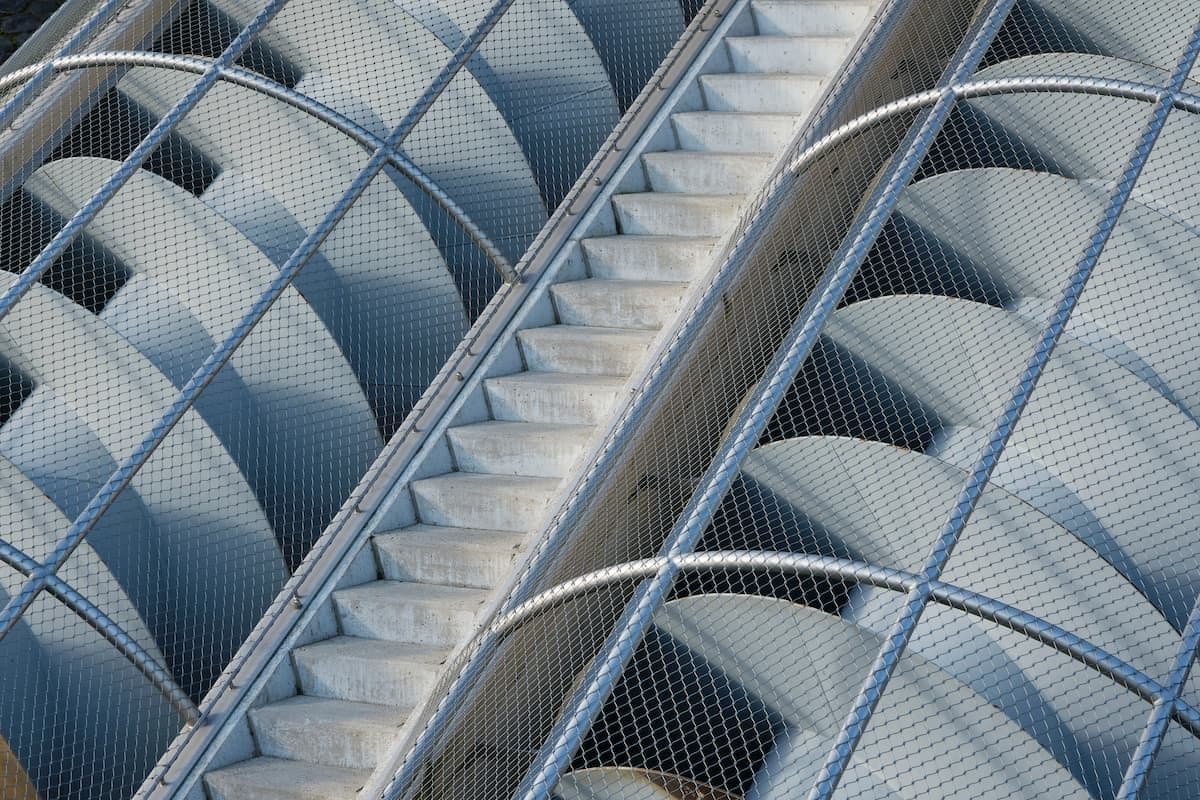
Wastewater inlet station energy cost reduced by €42k per year
Two screw pumps were running at under a third of nominal power. SAM4 Energy showed a single pump could carry the flow for most of the day.
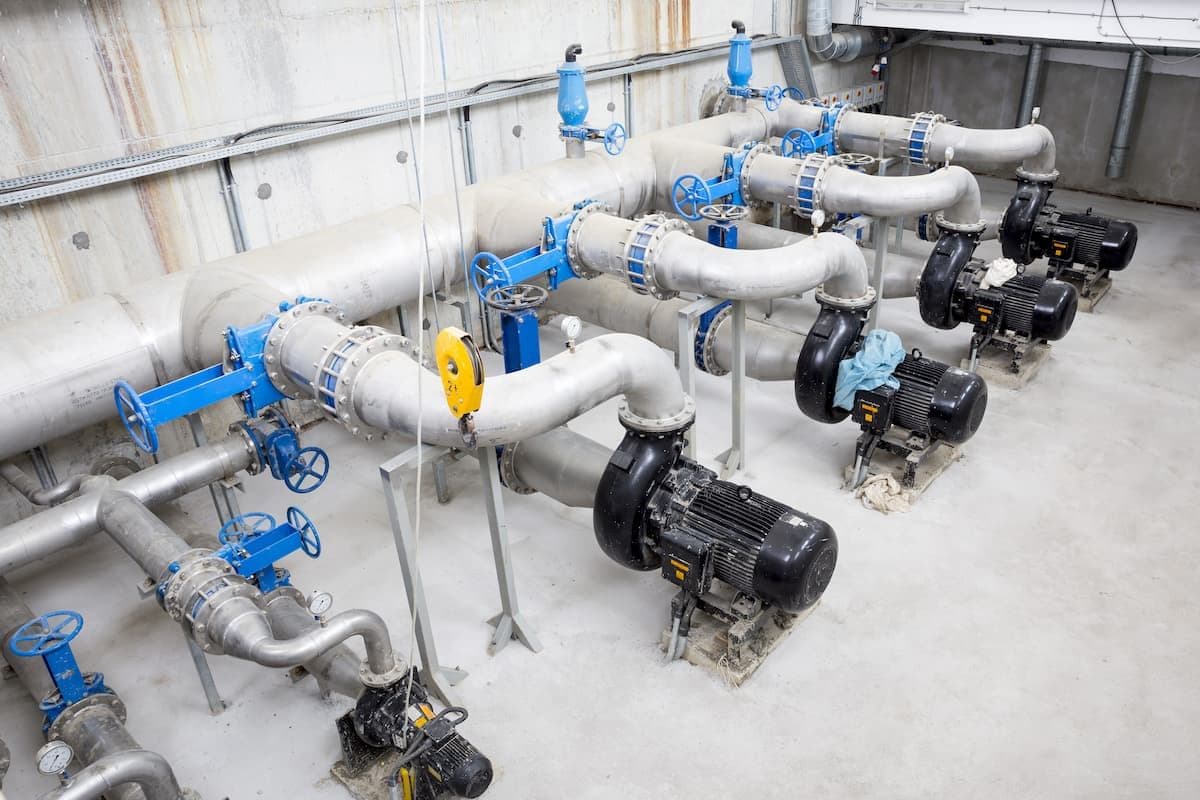
Rightsizing booster pumps to save €121k a year in wasted energy
SAM4 Energy identified a classic mismatch between pump size and system flow that was annually consuming 813 MWh more than it needed to.

Samotics' clogging detection technology identifies a blockage outside of the pump
The load signature pointed away from the pump itself. The blockage sat outside it, and the operator cleared it before high flow made it a pollution risk.

How Yorkshire Water saved £390k in potential fines
Three separate pollution events avoided through early alerts on sewage pumps, each caught in time for the utility to act before discharge.
“SAM4 delivers clear and actionable insights that enable our teams to make swift, informed decisions.”
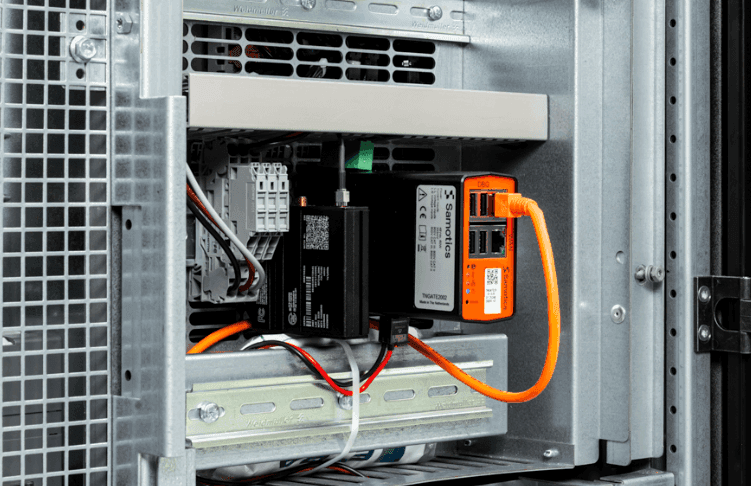
Under 60 minutes. Brief cabinet de-energisation. No pump access.
1. Open the motor control cabinet
SAM4 installs at the MCC: the same panel your electricians already access. No hot-side access, no ATEX hot-work permit.
2. Clip sensors onto motor supply cables
Current and voltage sensors clip directly onto existing motor cabling. Installation requires a brief motor de-energisation while sensors are fitted, typically scheduled with operations. No wiring changes.
3. Connect and commission
The SAM4 gateway connects via cellular (4G/LTE). No dependency on your IT network. Monitoring starts immediately, with first diagnostic results within 48 hours.

See SAM4 monitoring pumps
A 30-minute demo shows SAM4 running on pumps like yours. Real fault data. Real diagnostics. Real energy insights.