How It Works

How SAM4 reads motor-driven assets from the cabinet.

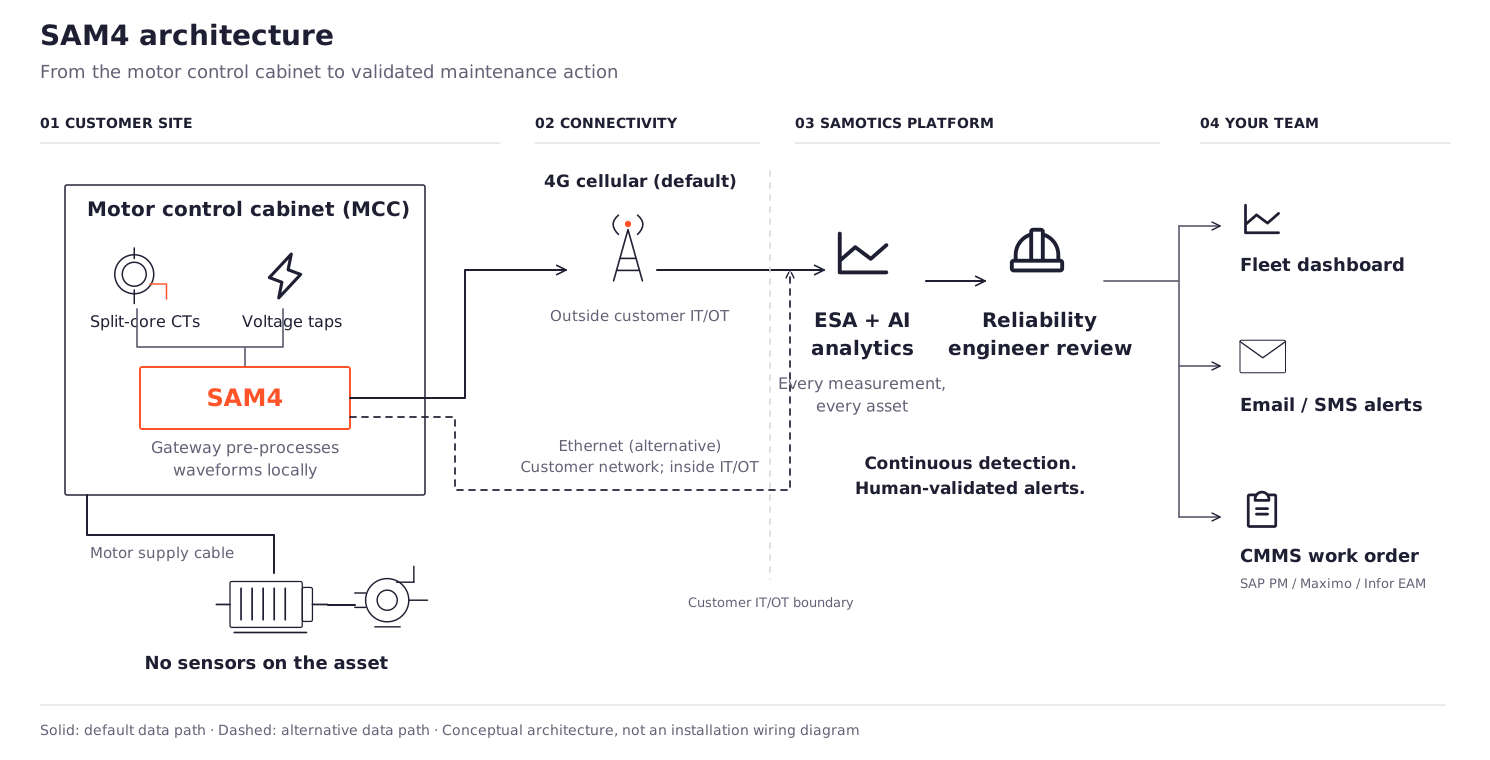
SAM4 installs inside the motor control cabinet and measures current and voltage from the motor supply. It detects developing electrical, mechanical, drivetrain, and hydraulic load-path fault evidence, validates findings with reliability engineers, and turns them into maintenance actions. No sensor on the asset. Brief planned cabinet intervention to install.

95.5%Recall on confirmed real conditions
2.1%Post-review false-alert rate
7,000+Monitored assets across industrial fleets
The monitoring blind spot

Vibration works well on machines you can reach. Many critical assets do not give you that access.

Submerged pumps, enclosed motors, ATEX-zone equipment, remote fans, and large fleets of smaller drives often run without continuous condition data. Not because they are unimportant, but because installing and maintaining sensors on the asset is impractical, expensive, or unsafe.

Manual inspection routes capture snapshots. They do not show how faults develop between visits. That leaves reliability teams reacting late, especially on the assets that are hardest to inspect.

SAM4 closes that gap from the motor control cabinet. It reads current and voltage at the MCC and turns the motor's electrical signal into condition data. No sensor on the machine. No routine asset access for monitoring.

Why the cable carries the condition

The motor couples the driven machine to the electrical supply.

How a fault travels into the electrical signal: a pump with cavitation and bearing wear feeds disturbances back through the shaft to the motor; the motor changes how it draws current; those changes appear as repeatable frequency components and sidebands in the current and voltage spectrum measured at the motor control cabinet.

When voltage becomes unbalanced, a bearing wears, a belt slips, a gearbox degrades, a pump cavitates, or a wet-well pump starts to rag, the motor can draw current and voltage differently. The change is small, but repeatable. It appears in the current and voltage waveforms that travel back through the motor cable to the cabinet.

SAM4 measures those waveforms at the MCC, converts them into the frequency domain, and detects patterns linked to electrical faults, drivetrain faults, and process or hydraulic load changes.

No sensor on the asset. The motor cable already carries the signal.

For the detailed physics, see the ESA explanation.

Detection portfolio

Fault patterns SAM4 can detect from the cabinet

SAM4 measures current and voltage at the motor control cabinet. Those signals contain direct evidence of electrical faults and indirect evidence of mechanical or process faults that change load, torque, speed, or electromagnetic behaviour.

Electrical faults are often visible directly in the motor's own signal. Mechanical and process faults propagate through the drivetrain and appear as load-path changes in the current and voltage spectrum.

Where faults appear in the electrical signal

Electrical faults are often visible directly. Mechanical and process faults are detected through their effect on the motor's electrical behaviour.

Grid

01
Direct electrical evidence
Voltage imbalance
Power quality issues
Harmonic distortion

VFD

02
Drive-related signal effects
Drive-induced harmonics
Switching behaviour
Resonance effects

Motor

03
Direct motor evidence
Electrical imbalance
Phase imbalance
Rotor bar defects

Transmission

04
Load-path evidence
Belt slip
Gearbox wear
Coupling misalignment

Load / process

05
Load-path evidence
Mechanical imbalance
Cavitation
Blockage

Detection confidence varies by asset type, operating regime, load stability, and available fault history. That is why SAM4 publishes performance by asset type, rather than relying on one blended number across all machines.

From cabinet to action

How a cabinet signal becomes a maintenance action

SAM4 installs at the motor control cabinet, captures current and voltage, analyses the electrical signal, and delivers validated findings your team can act on.

1

Install at the MCC

SAM4 measurement hardware is installed inside the motor control cabinet by qualified personnel, usually during a short planned cabinet intervention.

You avoid: asset-mounted sensors, routine machine access, scaffolding, wet-well entry, or ATEX-zone access for ongoing monitoring.

2

Capture current and voltage

SAM4 continuously samples high-frequency current and voltage waveforms across real operating conditions. Data is transmitted to the platform via cellular, Ethernet, or Wi-Fi.

You get: a continuous electrical signature for each monitored asset.

3

Analyse fault patterns

SAM4 converts waveform data into frequency spectra and compares each asset against known fault signatures and its own healthy baseline. Models are trained across more than 7,000 continuously monitored assets.

You get: early evidence of developing electrical, mechanical, or process-related fault patterns before they become operational failures.

4

Send a validated action

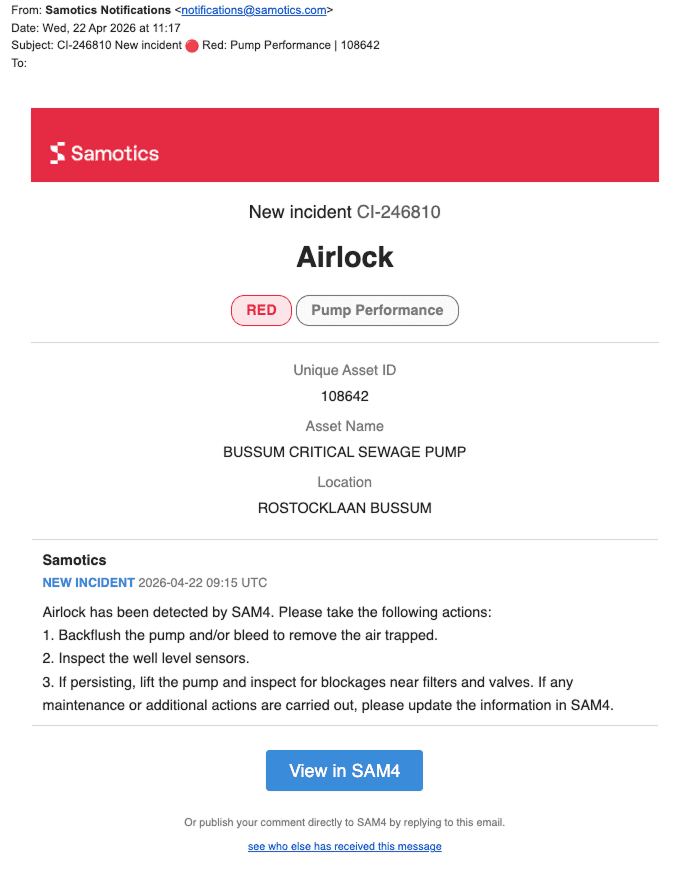
Validated findings include the likely fault, severity, diagnostic context, supporting evidence, and a recommended next step. Alerts route into your CMMS (SAP PM, IBM Maximo, Infor EAM), dashboard, email, or workflow API.

You get: a maintenance action, not raw signal data.

What analysis means in practice

SAM4 runs two detection tracks in parallel.

  • Model-driven detection looks for known fault signatures at expected frequencies.
  • Baseline detection compares each asset against its own normal behaviour.

Load, speed, and operating context help separate process changes from likely faults. Ambiguous or edge-case findings are reviewed by reliability engineers before they reach your team.

See the full method →

What you receive

Validated alerts, not raw anomalies

SAM4 does not just flag that something changed. Each alert explains which asset is affected, what fault is likely, how urgent it is, what evidence supports the finding, and what your team should do next.

Each alert contains

  • Asset — site, asset name, motor size, and drivetrain position.
  • Fault — likely fault class across motor, transmission, or load.
  • Severity — health state, urgency, and trend direction.
  • Evidence — signal features, spectral indicators, and diagnostic context.
  • Recommended action — a specific next step for this asset and this fault.
  • Workflow status — validated alerts can route into your CMMS as structured work orders.

Beyond fault detection, the same electrical signal supports energy and performance insights: power consumption, load behaviour, operating efficiency, and fleet-level outliers. Explore energy and performance monitoring →

From one asset to the whole fleet

SAM4 supports decisions at three levels using the same signal.

  • Asset level — condition, severity, evidence, and recommended action for one motor-driven machine.
  • Station level — combined health, recurring issues, capacity constraints, and local operating risk across a station, skid, or MCC group.
  • Fleet level — health trends, energy outliers, inefficient operating patterns, and investment priorities across sites or asset classes.
Field proof

Evidence from live fleets, not lab tests

SAM4 performance is measured on resolved customer-facing alerts from live industrial deployments.

“We've chosen Samotics as our sole supplier for ESA technology for the coming years because they have shown strong performance in the water industry and are the only company able to deliver this technology at scale.”

Matt ArmitageDynamic Maintenance Transformation Lead, Yorkshire Water
95.5%Recall on confirmed real conditionsShare of confirmed real conditions detected by SAM4. 1,467 scored incidents, 12 months ending 1 May 2026.
2.1%Post-review false-alert rateFalse-alert share after expert validation.
3Monitoring regionsFollow-the-sun review coverage across Europe, Asia, and the Americas.
Why this matters for your role

What each team gets from SAM4

SAM4 gives reliability, operations, and maintenance teams the same source of truth: validated asset condition from the motor control cabinet.

Reliability Manager

Where is risk building across the fleet?

SAM4 extends condition monitoring beyond the assets that are easy to reach. You get ranked health, fault evidence, and traceable confirmations across monitored motors and driven assets.

  • Coverage beyond accessible, high-criticality machines
  • Asset, station, and fleet-level health views
  • Evidence for reliability reports and rollout decisions
OutcomeProve fleet coverage

Operations Director

Which failures could disrupt service or production?

SAM4 helps operations teams move from reactive response to planned intervention. You see where asset risk is rising before it turns into downtime, service disruption, or emergency maintenance.

  • Fewer unplanned stoppages on critical processes
  • Quantifiable avoided downtime and risk reduction
  • Visibility into asset risk and inefficient operation
OutcomeProtect uptime

Maintenance Engineer

What should I inspect, and how urgent is it?

SAM4 sends validated alerts with likely fault type, severity, evidence, and a recommended next step. Your team acts on confirmed findings, not raw anomaly noise.

  • Fault type, location, severity, and supporting evidence
  • Recommended action for the specific asset and fault
  • CMMS-ready alerts with feedback into the monitoring loop
OutcomeKnow what to do next
ABB drive integration

Already running compatible ABB drives? The signal is already there.

ABB embedded Samotics ESA into its ACS880 drive portfolio. For compatible drives, SAM4 can analyse current and voltage signals already measured by the drive, reducing the need for additional cabinet measurement hardware.

The drive captures the electrical signal. SAM4 applies ESA analytics, expert validation, and maintenance workflow integration. The result is the same: validated findings with likely fault type, severity, evidence, and recommended action.

Compatibility is confirmed during scoping. If your assets do not run on compatible ABB drives, SAM4 can install cabinet measurement hardware at the MCC to capture the same current and voltage signals.

Read the ABB press release · Check ABB drive compatibility →

ABB
Compatible ACS880 drive
Measures current and voltage
ESA
SAM4 ESA analytics
Detects fault signatures in the signal
REV
Expert validation
Reviews ambiguous and high-impact findings
Maintenance action
Validated alert or CMMS-ready work order

Common questions about deployment and fit.

Typical install is under 60 minutes per drivetrain. Sensors clamp inside the motor control cabinet. During installation, de cabinet needs a brief de-energization. Back online the next shift. On ABB-drive-embedded deployments, there is no cabinet work at all.

Detection starts at install. SAM4 does not require a multi-week training or baseline-building phase. Two analysis tracks run in parallel from day one. Physics-based detection looks for fault types with known electrical signatures — voltage imbalance, current imbalance, stator winding indicators, broken rotor bar sidebands, and bearing-related modulation patterns. These appear at expected frequencies and do not depend on asset history. Asset-specific baseline detection builds each machine's healthy operating envelope from the first measurements and refines it as more operating context comes in. Both tracks contribute to detection from the first measurements onward.

SAM4 supports many VFD-driven motors. Detection confidence depends on drive topology, switching behaviour, load profile, operating regime, and fault mode. The ESA page documents where confidence is reduced. We review these factors during asset-fit scoping.

SAM4 pushes alerts to SAP PM, IBM Maximo, Ultimo, Oracle eAM, and any system with a REST or webhook endpoint. Standard integrations are documented; custom mappings are configured during onboarding.

Current and voltage waveforms are encrypted locally and streamed to the Samotics cloud on EU or regional infrastructure. Data ownership remains with the customer. Contract covers retention, export, and deletion terms.

Two safeguards. First, every candidate alert that lands on your desk has been reviewed by a Samotics reliability engineer; ambiguous detections are filtered before notification. Second, the false-alert share after expert review is in the low single-digit range across customer-facing alerts. If a customer's site is producing noisy alerts, we recalibrate per-asset baselines rather than dump raw output.

Typical first deployment: the assets that stop production when they fail and currently have no condition monitoring. Centrifugal pumps, fans, conveyors, and gearbox-driven motors are the highest-yield entry points. We shortlist candidates together during scoping.

ESA and vibration are complementary, not competitive. Vibration excels on accessible, high-criticality rotating assets. ESA covers what vibration cannot reach: submerged or enclosed motors, electrical faults, fleet-wide low-cost coverage. See the full comparison.

Both. The cabinet gateway pre-processes raw current and voltage into failure indicators locally, which makes the system viable on low-bandwidth and offshore sites. Spectral analysis, baseline comparison, and engineer review happen in the cloud, where each asset benefits from learning across the wider monitored fleet. Customers in restrictive network environments can run with reduced cloud transmission.

See SAM4 running on your fleet.

A 45-minute walkthrough with a Samotics reliability engineer. Bring an asset list; leave with a deployment shortlist.